




 English
  Español
  русский


DN10 Stainless Steel Gas Connector: Safe, Flexible, and Durable Connection Performance
Modern gas systems require connection components that combine flexibility, corrosion resistance, dimensional accuracy, and dependable sealing. A gas connector may appear simple compared with a boiler, cooking appliance, heating unit, or industrial gas installation, but it performs a critical safety function. It must transport gas reliably while accommodating movement, vibration, installation tolerances, temperature changes, and limited installation space. The DN10 stainless steel gas connector is designed to address these requirements through a carefully selected material structure, practical connection options, a broad length range, and controlled manufacturing processes.
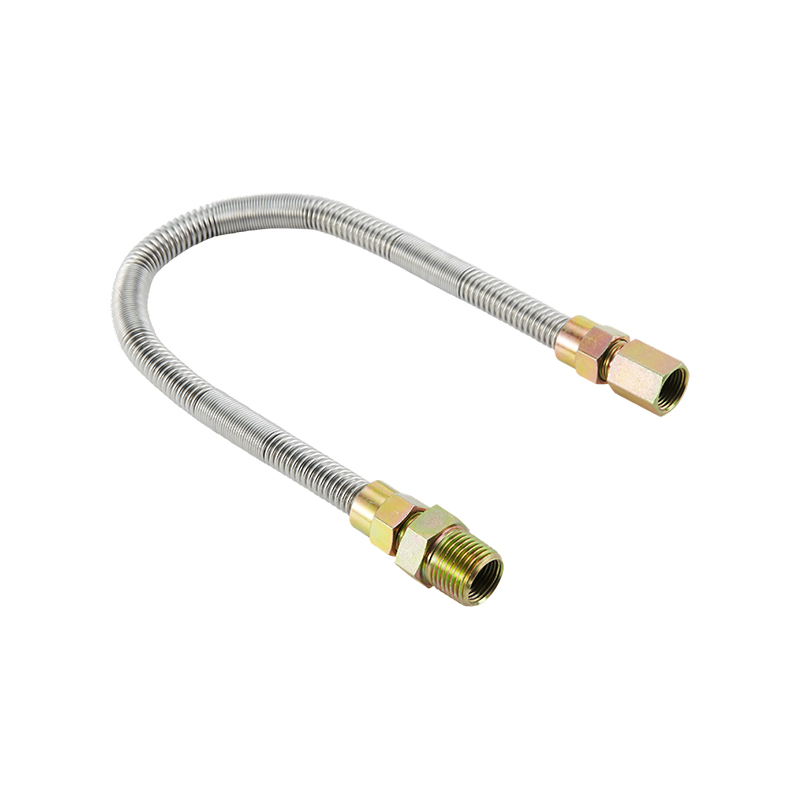
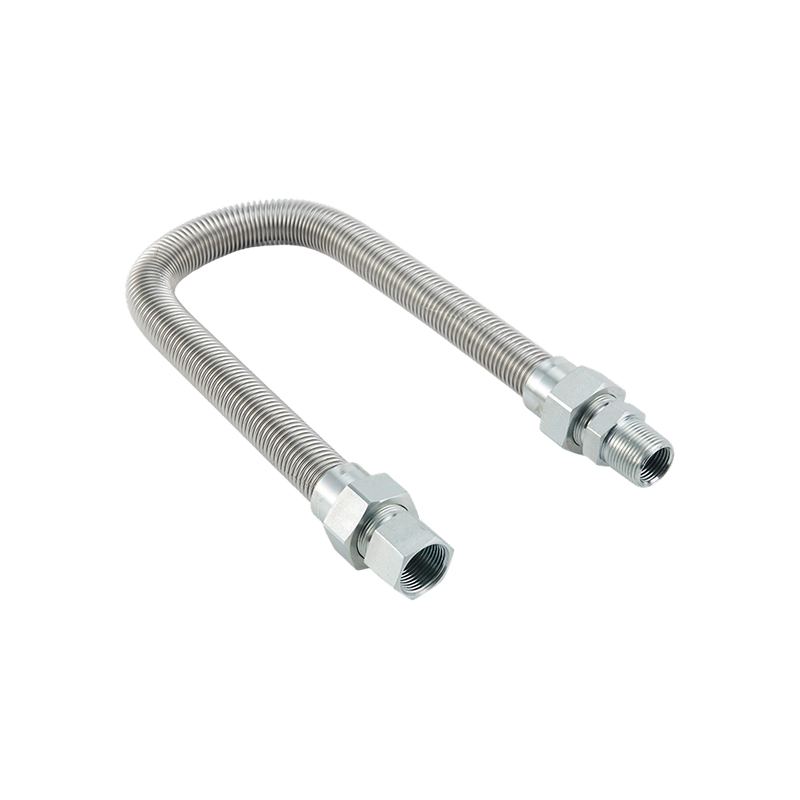
Made from 304 stainless steel with a stated wall thickness of 0.2 millimeters, this connector is intended for residential and commercial gas systems. Its corrugated flexible tube construction enables easier routing than rigid metal pipe while maintaining a durable metallic barrier between the gas medium and the surrounding environment. The product is available in lengths from 12 inches to 72 inches and can be supplied with several adapter configurations. This combination allows installers to select a suitable connection for kitchens, commercial appliances, heating equipment, and other gas applications.
The connector is manufactured by Haoyin (Ningbo) Bellows Technology Co., Ltd., a specialist enterprise focused on stainless steel bellows and flexible connection technologies. The company serves gas, plumbing, heating, healthcare, building heating, industrial HVAC, and related sectors. Its capabilities include product research and development, structural design, stainless steel forming, laser welding, CNC processing, performance testing, eddy current inspection, and automated packaging. These capabilities support a full-process approach to quality control rather than relying only on final visual inspection.
This article examines the product’s construction, connection system, material advantages, manufacturing strengths, installation value, application range, and comparison with less specialized alternatives. It also explains important selection considerations and provides a practical question-and-answer section for purchasers, distributors, engineers, and installers.
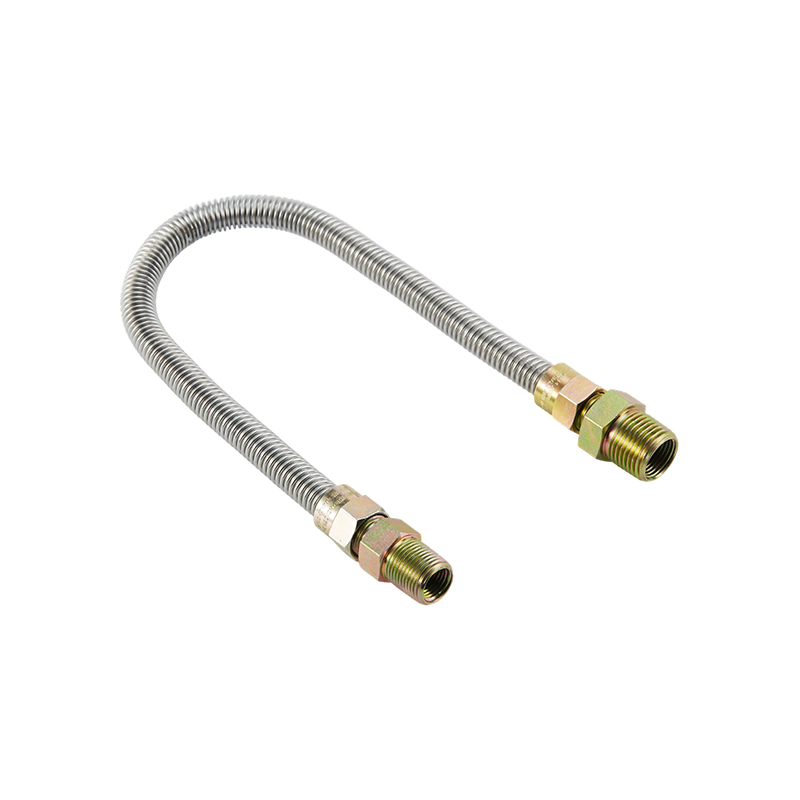
DN10 Stainless Steel Gas Connector
1. Product Overview and Intended Function
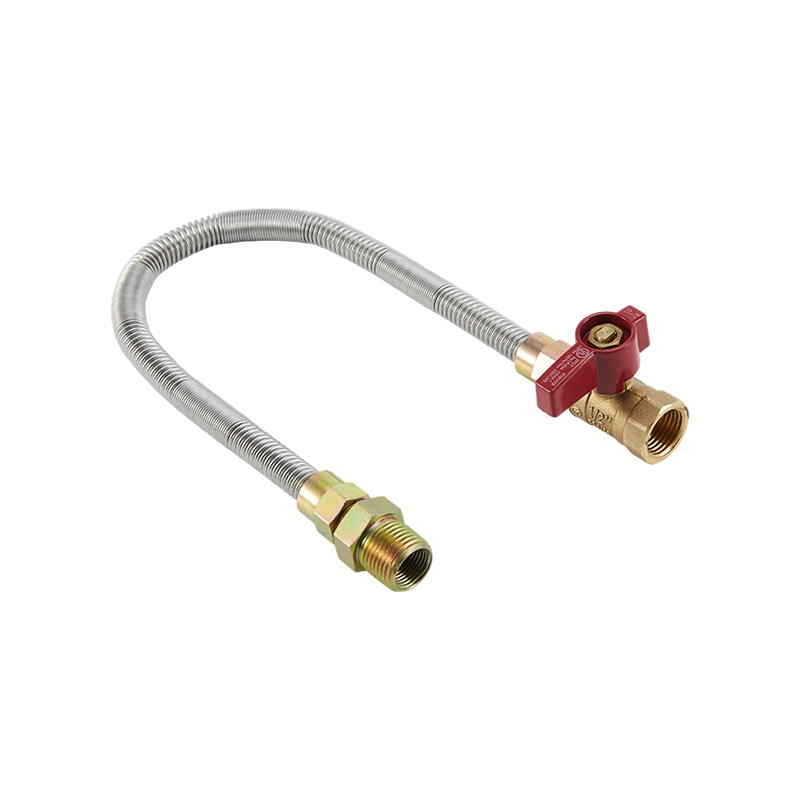
The DN10 stainless steel gas connector is a flexible metallic connector for gas equipment and gas piping arrangements. The DN10 designation identifies the nominal product size class, while the specific end connection uses a 5/8-18UNF flare nut arrangement. The connector is not simply a length of flexible tube. It is a complete connection assembly that combines a formed stainless steel tube, end fittings, nuts, and sealing surfaces designed to work together.
In a typical installation, one end of the connector attaches to a gas appliance or equipment inlet, while the other end connects to a fixed gas supply pipe, valve, adapter, or fitting. The flexibility of the tube helps installers avoid sharp alignment problems and reduces the need to position the appliance with extremely precise accuracy before the final connection is made. This is particularly useful when the appliance must be moved for cleaning, inspection, maintenance, or replacement.
Gas connectors are exposed to demanding conditions. They may be installed near cooking equipment, heating appliances, cabinets, walls, floors, or service compartments. They can encounter humidity, cleaning residues, temperature fluctuations, vibration, and occasional mechanical movement. A suitable connector therefore needs more than nominal pressure capacity. It must also retain its shape, resist surface deterioration, protect the gas pathway, and provide a reliable seal over its service life when properly selected and installed.
The DN10 model is designed around these practical requirements. Its 304 stainless steel body provides a corrosion-resistant metallic structure. The 0.2 millimeter wall thickness offers a balance between flexibility and material integrity. The flare connection provides a defined sealing interface, while the available adapters support different pipe and thread arrangements. The result is a connection component that can simplify installation without sacrificing the durability expected from a metal gas product.
2. Main Specifications
The following table summarizes the principal product information supplied for this model. Actual selection should always consider the complete system design, applicable local regulations, equipment instructions, and the required certification or approval for the installation location.
| Specification | Product Information |
|---|---|
| Product type | DN10 stainless steel gas connector |
| Primary material | 304 stainless steel |
| Stated wall thickness | 0.2 millimeters |
| Flare nut | 5/8-18UNF |
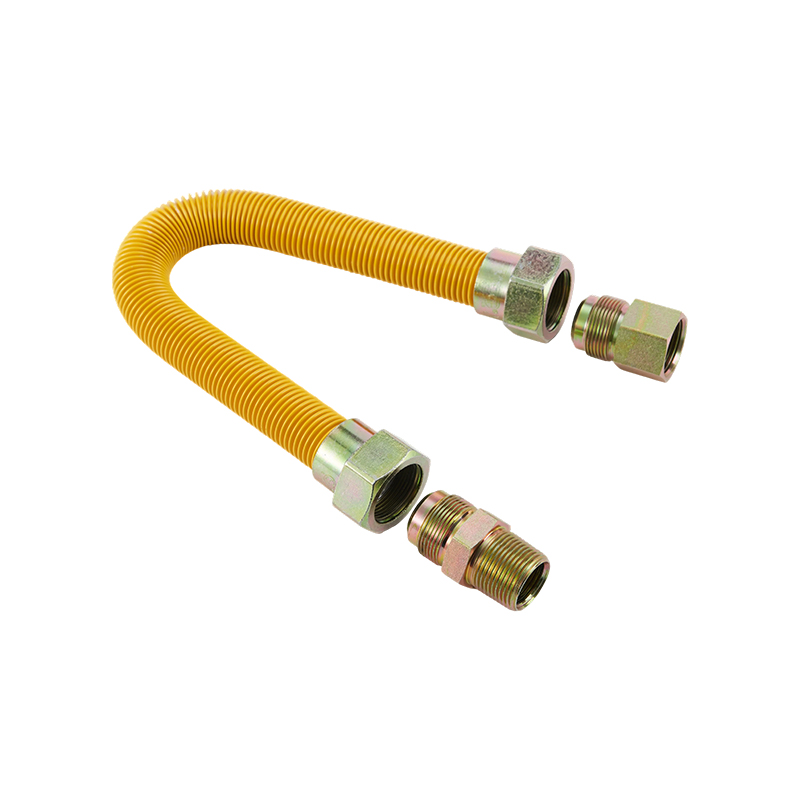
| Available adapter configurations | 3/8 inch outside diameter flare to 3/8 inch male pipe thread, 3/8 inch female pipe thread, 1/2 inch male pipe thread with 3/8 inch female pipe thread option, and 1/2 inch female pipe thread |
| Available lengths | 12, 18, 24, 36, 48, 60, and 72 inches |
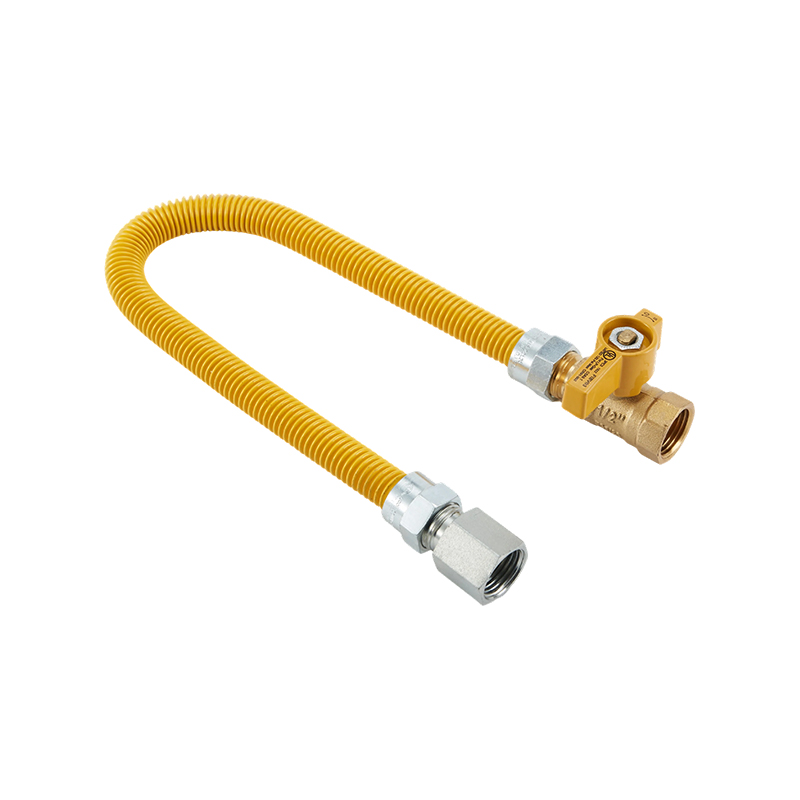
| Connector colors | Stainless steel, yellow, and black |
| Nut materials | Brass or carbon steel |
| Cover material | None specified; supplied as a metal connector without an additional cover |
| Sealing form | Hard sealing |
| Product category | Stainless steel gas connector with CSA certificate category designation |
The range of sizes and connection options is important because gas installations are rarely identical. A connector that fits one appliance may not fit another without an adapter. By offering several end configurations, the product can support different interfaces while preserving a common connector body and manufacturing platform. This can simplify purchasing, inventory planning, and product selection for distributors and installation contractors.
3. 304 Stainless Steel Construction
The use of 304 stainless steel is one of the most important product advantages. This stainless steel grade is widely used in equipment exposed to moisture, household environments, commercial kitchens, plumbing systems, and industrial applications. It contains chromium that supports the formation of a passive surface layer, helping the material resist ordinary atmospheric corrosion and many common environmental exposures.
For a gas connector, corrosion resistance contributes to long-term reliability in several ways. The outer surface is less likely to deteriorate rapidly in humid locations. The tube is better suited to environments where condensation or occasional water exposure may occur. The fitting assembly also benefits from a durable metallic base that can maintain its mechanical characteristics when handled correctly during installation.
Material selection must not be confused with unlimited resistance. Stainless steel performance depends on the surrounding chemicals, temperature, mechanical conditions, cleaning agents, and installation environment. Chloride-rich materials, aggressive chemicals, abrasion, and incorrect handling can affect any metal. Nevertheless, 304 stainless steel provides a strong and widely accepted foundation for general gas connector applications, particularly when compared with ordinary uncoated carbon steel or lower-grade materials.
Competitor products made from plain steel may require protective coatings to reduce corrosion. Coatings can be effective, but scratches, cuts, bending damage, or poor surface preparation may expose the underlying metal. A stainless steel tube has corrosion resistance inherent in its material rather than depending entirely on an external coating. This is a significant advantage in installations where the connector may be handled during appliance movement or where surface wear is possible.
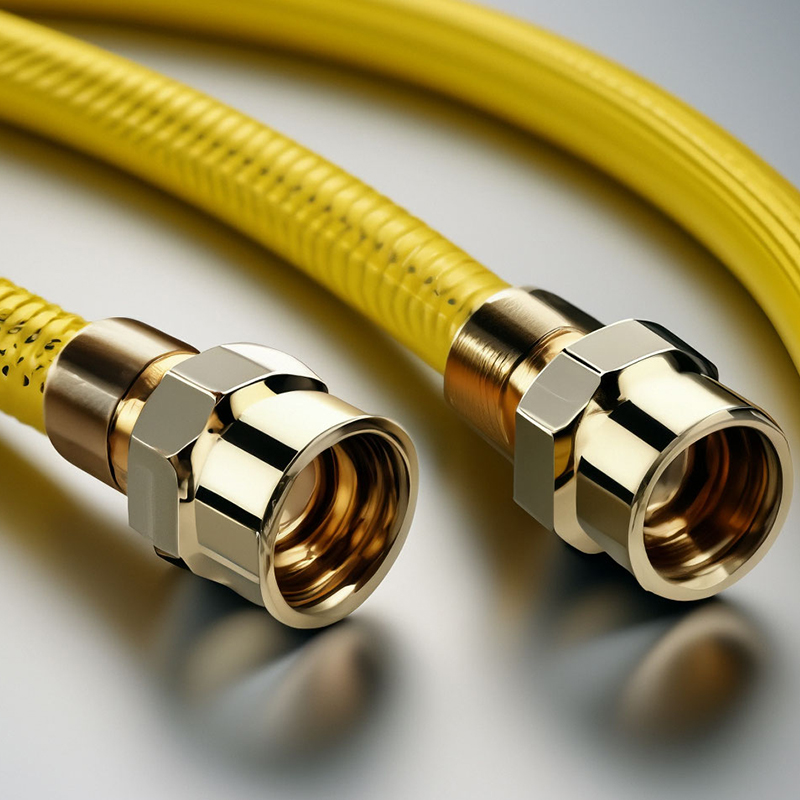
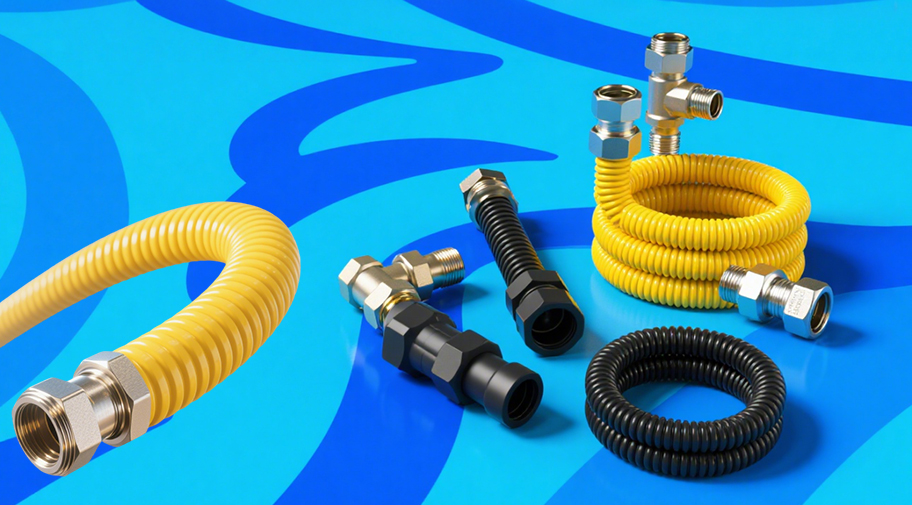
The stainless steel body also offers a clean and professional appearance. This matters in residential kitchens, visible commercial installations, appliance service areas, and equipment rooms where the connector may remain partly exposed. The product can be supplied in stainless steel, yellow, or black, allowing distributors and equipment manufacturers to select a finish that suits their application and visual requirements.
4. Flexible Corrugated Tube Design
The flexible tube is designed to accommodate routing requirements that would be difficult for rigid pipe. Instead of requiring a perfectly straight line between the gas supply and appliance inlet, a flexible connector can follow a controlled curve. This can reduce the number of elbows, couplings, and intermediate fittings needed in a compact installation.
Flexibility is especially valuable behind kitchen equipment and in commercial appliance spaces. Cabinets, walls, valves, and appliance housings may not be aligned in a convenient way. A rigid pipe arrangement may require additional fabrication and more connection points. Each additional connection can increase installation time and create another location that must be inspected for correct sealing. A properly selected flexible connector can make the arrangement simpler and more accessible.
The corrugated structure increases the tube’s ability to bend compared with a smooth rigid tube of similar material. However, flexibility does not mean that the connector should be twisted, sharply kinked, crushed, stretched, or repeatedly bent beyond its intended radius. The connector should be routed in a smooth curve, protected from excessive mechanical stress, and installed according to the equipment and local code requirements.
The 0.2 millimeter wall thickness is a carefully stated product characteristic. It helps create a lightweight connector that remains practical to form and route. A thin, accurately manufactured stainless steel wall can provide useful flexibility while maintaining a continuous gas barrier. The balance between wall thickness, corrugation geometry, weld quality, and end-fitting attachment is more important than wall thickness alone. A thicker tube is not automatically a better connector if it is difficult to route or poorly integrated with the fittings.
Compared with low-cost flexible products using inconsistent tube geometry, a controlled corrugated structure can provide more predictable bending behavior. Consistency helps installers avoid unexpected stiff sections, irregular deformation, or uneven end alignment. It also supports repeatable production and more reliable inspection results.
5. Flare Connection and Adapter Compatibility
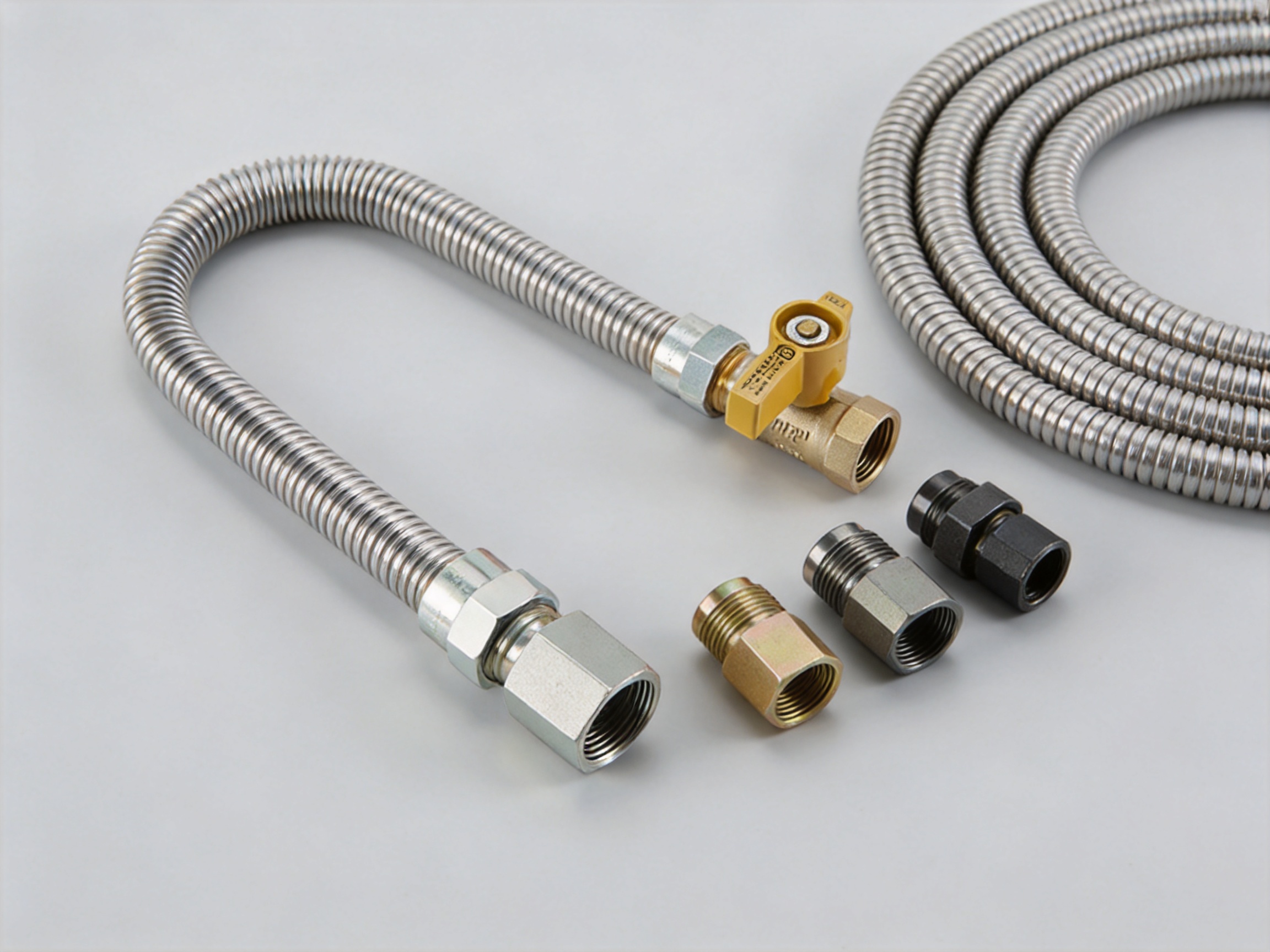
The product uses a 5/8-18UNF flare nut arrangement. Flare connections are designed around a defined mating surface rather than relying only on thread engagement. The threads position and tighten the nut, while the flare surfaces provide the sealing interface. This is the basis of the stated hard sealing form.
A properly made flare connection can provide a dependable metal-to-metal seal when the mating components are correctly matched, clean, aligned, and tightened according to the relevant installation instructions. Because the seal is formed at the flare surface, the installer must avoid contamination, cross-threading, damaged flare faces, and excessive tightening. Thread sealant should not be applied to a flare sealing face unless specifically required by the applicable system design; sealants are generally associated with compatible tapered pipe threads rather than the flare surface itself.
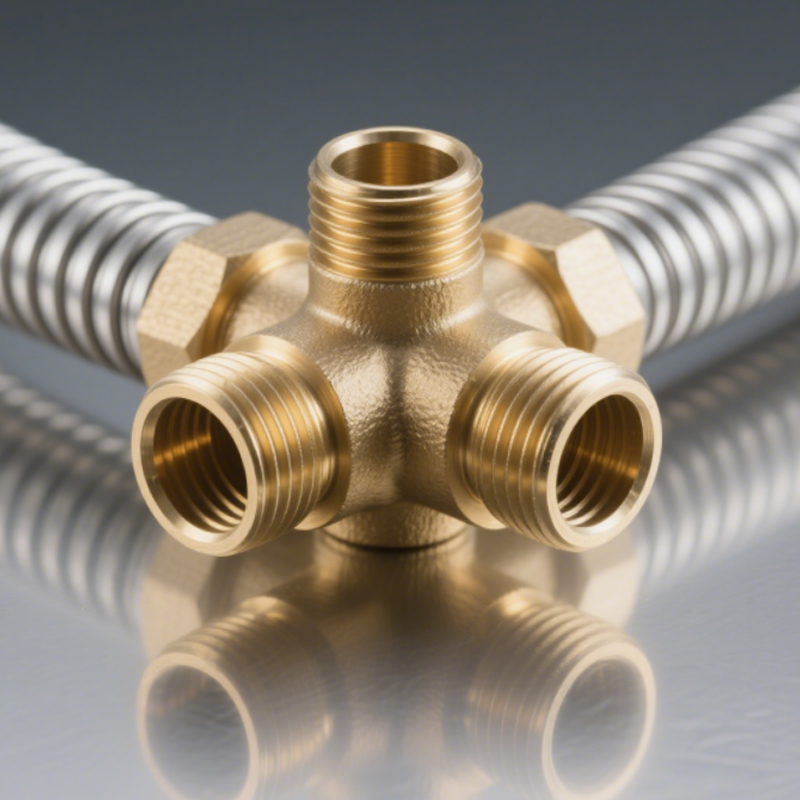
The adapter options expand the product’s usefulness. The listed configurations include connections associated with 3/8 inch outside diameter flare, 3/8 inch male pipe thread, 3/8 inch female pipe thread, 1/2 inch male pipe thread, and 1/2 inch female pipe thread. One configuration includes a 1/2 inch male connection with a 3/8 inch female option. These combinations allow the connector to interface with different valves, appliance inlets, rigid pipe sizes, and fitting arrangements.
Connection compatibility must always be confirmed by thread type, nominal size, gender, flare geometry, and applicable standard. Nominal dimensions that appear similar may not be interchangeable. A professional installer should verify every interface before installation rather than relying only on visual similarity. Correct adapter selection prevents forced assembly, leakage risk, damaged threads, and unnecessary modification of the gas system.
Compared with a connector available in only one fixed fitting configuration, this model provides more purchasing flexibility. A distributor can offer several end options from one product family. An installer can select the correct configuration for a specific appliance without replacing the entire connector with a different body style. This can reduce project delays and improve stock efficiency.
6. Length Options for Practical Installation
The DN10 connector is available in seven stated lengths: 12, 18, 24, 36, 48, 60, and 72 inches. This range covers short appliance connections as well as longer routing requirements. Length selection should be based on the actual installation path, required service access, permitted bend radius, and local regulations.
A connector that is too short may place strain on the fittings or force the appliance into an unsuitable position. A connector that is excessively long may create unnecessary loops, contact nearby surfaces, or become difficult to inspect. The best practice is to select the shortest length that allows a smooth, unstressed route and the necessary movement for service.
The availability of standardized lengths supports more efficient installation planning. Contractors can estimate requirements before arriving at the job site, while wholesalers can organize inventory around common sizes. Appliance manufacturers and equipment integrators can also specify a length that fits a particular product configuration without requiring custom fabrication for every order.
Length variety can be a competitive advantage over products offered in only one or two sizes. It also reduces the temptation to create unsafe routing by sharply bending an undersized connector or coiling an excessively long one. A more complete range helps the installer make a technically appropriate choice.
7. Advantages Compared with Common Alternatives
7.1 Compared with Rigid Metal Pipe
Rigid pipe offers strength and permanence, but it often requires accurate measurement, cutting, threading, bending, and alignment. In appliance connections, rigid pipe can make installation more labor-intensive and may transmit movement or vibration directly to the equipment connection. A flexible stainless steel connector can simplify the final connection and accommodate minor positional differences.
The connector does not replace the need for properly designed rigid piping. Instead, it provides a practical transition between the fixed gas supply and movable or serviceable equipment. It is particularly useful where an appliance may need to be pulled forward for inspection or cleaning, subject to applicable code requirements and the equipment manufacturer’s instructions.
7.2 Compared with Ordinary Uncoated Steel
Uncoated carbon steel can be vulnerable to rust when exposed to moisture or corrosive conditions. Rust can affect appearance, wall integrity, and fitting performance. The 304 stainless steel body offers a more durable surface for many general service environments and does not depend on paint or plating as its primary corrosion defense.
7.3 Compared with Low-Quality Flexible Connectors
Low-cost products may compete mainly on price while providing limited information about material grade, wall thickness, fitting construction, inspection, or production control. A product supported by documented material specifications and a specialist manufacturing organization offers greater transparency. The stated 304 stainless steel material, 0.2 millimeter wall thickness, defined flare nut, adapter range, and available lengths help purchasers evaluate the product using objective criteria.
Manufacturing consistency is another differentiator. The quality of a flexible connector depends on tube forming, corrugation uniformity, end preparation, welding, fitting attachment, thread accuracy, and final inspection. A supplier with dedicated bellows and flexible connection experience is better positioned to control these details than a general metal component producer with limited experience in thin-wall corrugated products.
7.4 Compared with Products Requiring an External Protective Cover
This model is specified without a cover material. That can make the product lighter, more compact, and easier to inspect visually. In some applications, a bare stainless steel construction is preferred because the installer can see the tube condition and fittings clearly. However, the absence of a cover also means that the connector must be routed away from sharp edges, excessive abrasion, direct flame, and other hazards. Application conditions should determine whether a covered or protected design is required.
8. Manufacturing Expertise and Process Control
Product performance begins with manufacturing control. A stainless steel gas connector contains several features that must work together: a thin corrugated tube, welded or formed ends, threaded nuts, adapter interfaces, and a sealing surface. Minor inconsistencies in any one of these areas can affect assembly and service reliability. Haoyin’s specialization in stainless steel bellows provides a technical foundation for producing flexible metallic components rather than treating the connector as a basic commodity tube.
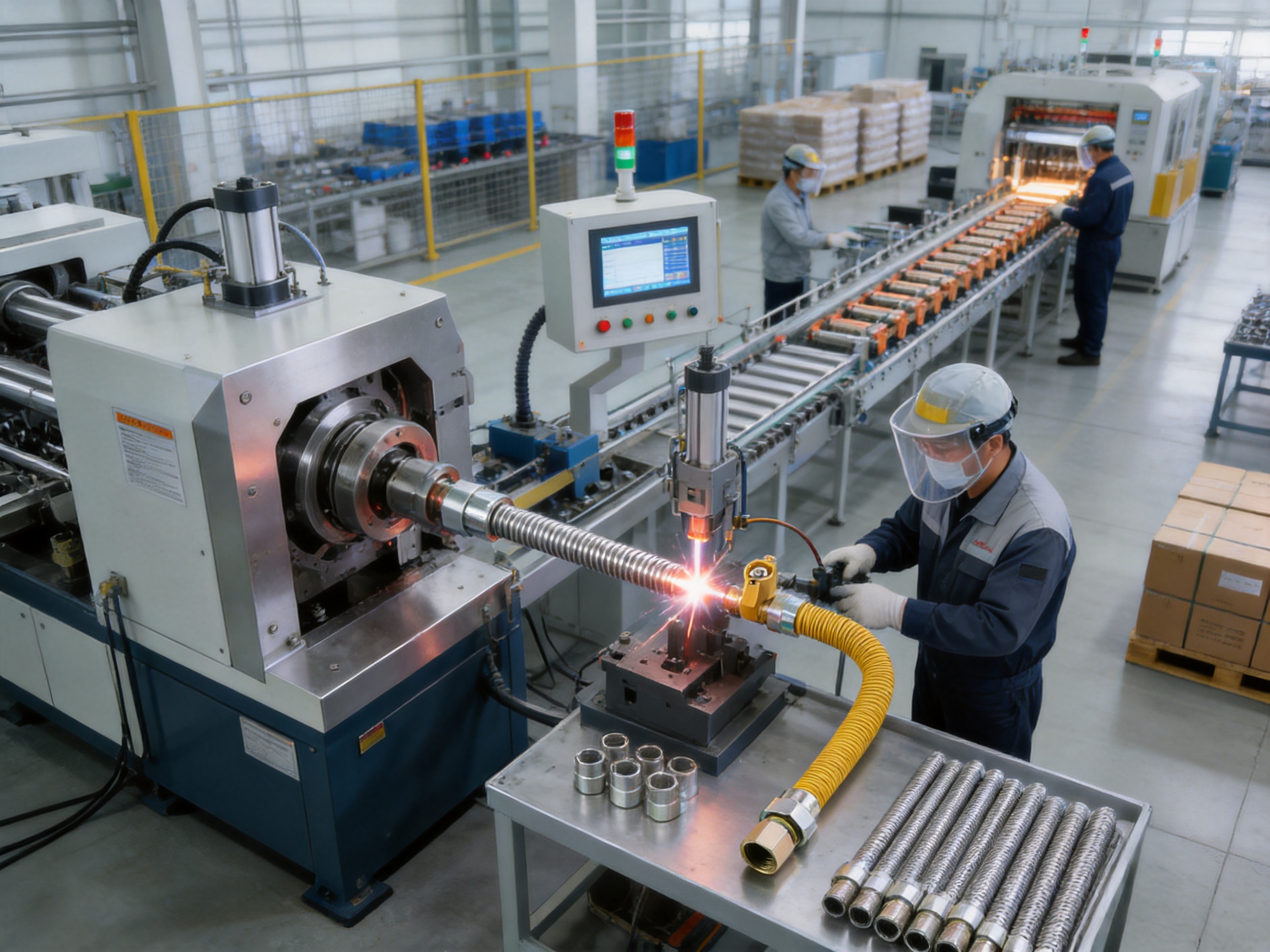
The company operates standardized workshops covering approximately 18,000 square meters within a larger area of about 35 mu. This production environment supports organized material flow, dedicated equipment, process separation, and systematic inspection. A structured factory layout is important for thin-wall stainless steel products because uncontrolled handling can cause dents, contamination, deformation, or mix-ups between specifications.
The company’s equipment includes laser welding machines. Laser welding can provide a concentrated heat source and precise energy control, which are valuable when joining thin stainless steel components. Properly controlled laser welding may reduce excessive heat input, limit distortion, and produce consistent weld geometry. Weld quality remains dependent on material preparation, alignment, parameter control, operator competence, and inspection, but the equipment provides a strong technical platform for repeatable production.
CNC forming machines are used for controlled shaping operations. Flexible bellows and corrugated tubes require consistent geometry across the full production length. CNC-controlled forming can help maintain repeatable pitch, depth, profile, and dimensional accuracy. Consistent forming supports predictable bending behavior and helps ensure that the end fittings align correctly with the tube axis.
The company also uses COSMO equipment and eddy current flaw detectors. Eddy current inspection is particularly relevant to conductive metal products because it can identify certain surface and near-surface discontinuities without destroying the component. When integrated into a broader inspection plan, this type of testing can help detect defects that may not be visible during a basic visual check.
Automatic packaging systems provide another process advantage. Packaging is not merely a logistics step. A connector can be damaged after passing production inspection if it is loosely packed, crushed, contaminated, or exposed to unsuitable storage conditions. Automated packaging can improve consistency, reduce handling variation, protect fittings, and support traceable order fulfillment.
The company describes a full-process quality management system covering raw material selection, structural design, manufacturing, performance testing, and after-sales support. This approach is important because final inspection alone cannot correct every process problem. Quality should be designed into the product through controlled specifications, approved materials, equipment maintenance, process documentation, inspection checkpoints, and feedback from field use.
9. Certifications and Quality Management
The product category identifies the connector as a stainless steel gas connector with CSA certificate designation. Certification requirements vary by market, product configuration, fuel type, installation method, and applicable standard. Purchasers should request the relevant certificate or conformity documentation for the exact model, length, fitting combination, and intended application rather than assuming that a general product description covers every variation.
The manufacturer has obtained ISO9001, ISO14001, and ISO45001 management system certifications according to the supplied company information. ISO9001 relates to quality management, ISO14001 to environmental management, and ISO45001 to occupational health and safety management. These systems do not replace product certification, but they demonstrate that the company has established formal management practices covering important operational areas.
A management system provides value when it is actively implemented. For a gas connector manufacturer, useful practices may include incoming material verification, batch identification, production records, calibration of measuring equipment, nonconformance control, corrective action, worker training, and customer complaint analysis. These activities create a documented path from raw stainless steel material to finished connector.
Quality documentation is particularly important for distributors and original equipment manufacturers. It can support supplier evaluation, product traceability, technical file preparation, incoming inspection, and customer service. A professional supplier should be able to clarify material grades, fitting specifications, available test reports, certification scope, packaging details, and production lead-time expectations.
10. Research, Development, and Engineering Capability
Flexible connectors are influenced by many interacting variables. Tube diameter, wall thickness, corrugation profile, bend radius, fitting geometry, welding method, sealing surface, and end restraint all affect performance. A company with an active research and development team can optimize these variables for different applications rather than using one generic design for every market.
Haoyin’s stated research and development capabilities include structural design and product development for stainless steel bellows and flexible connections. This experience is relevant to gas connectors because the tube must remain flexible without losing dimensional stability. Engineering development may also support new adapter combinations, alternative lengths, special packaging, color options, and application-specific configurations.
Advanced equipment such as laser welding, CNC forming systems, inspection instruments, and automated packaging is most useful when supported by engineering knowledge. Equipment alone does not guarantee quality. The combination of suitable machinery, trained personnel, controlled parameters, and product testing creates a more reliable manufacturing system.
The company’s status as a National High-tech Enterprise and Green Factory, as stated in the supplied information, further reflects an emphasis on technical development and organized production. Environmental and occupational management can support more efficient resource use, safer factory operations, and improved process discipline. These factors may not be visible in the finished connector, but they influence supply reliability and long-term supplier performance.
11. Application Areas
11.1 Residential Kitchens
Residential kitchens often have limited space and multiple surrounding surfaces. A flexible stainless steel connector can simplify the connection between a cooking appliance and the household gas supply. The available 12 to 72 inch length range allows the installer to select a suitable route for compact or more spacious layouts. The connector may also be useful when a cooker or range needs limited movement for maintenance, provided the installation is permitted by local requirements.
11.2 Commercial Food-Service Equipment
Commercial kitchens place greater demands on equipment access, cleaning routines, heat management, and service frequency. A suitable connector can help connect cooking appliances, ovens, grills, and other gas equipment where flexible routing is required. The stainless steel body is well suited to professional environments, but the connector should be positioned to avoid direct flame, excessive radiant heat, sharp equipment edges, and repeated dragging across the floor.
11.3 Heating Equipment
Gas-fired heating equipment may require flexible connections during installation or servicing. The appropriate connector length and adapter configuration can reduce alignment difficulty. Temperature exposure must be evaluated carefully, especially near burners, flue components, and hot surfaces. The connector must be used only within the temperature, pressure, and application limits established by the product documentation and applicable standards.
11.4 Commercial and Building Services
Commercial buildings may use gas appliances in kitchens, utility rooms, laboratories, workshops, or heating areas. The connector’s corrosion-resistant stainless steel construction and multiple connection options can support a variety of building service arrangements. Larger projects may benefit from standardized procurement, consistent product specifications, and coordinated packaging for different appliance zones.
11.5 Industrial and HVAC-Related Installations
Industrial and HVAC systems often contain vibration, thermal movement, and equipment servicing requirements. Metal flexible connectors can help manage limited movement and simplify equipment connections. However, industrial service conditions can be more severe than residential use. Engineers should evaluate pressure, temperature, gas composition, vibration frequency, chemical exposure, support conditions, and inspection access before approving the product for a particular duty.
12. Installation and Handling Considerations
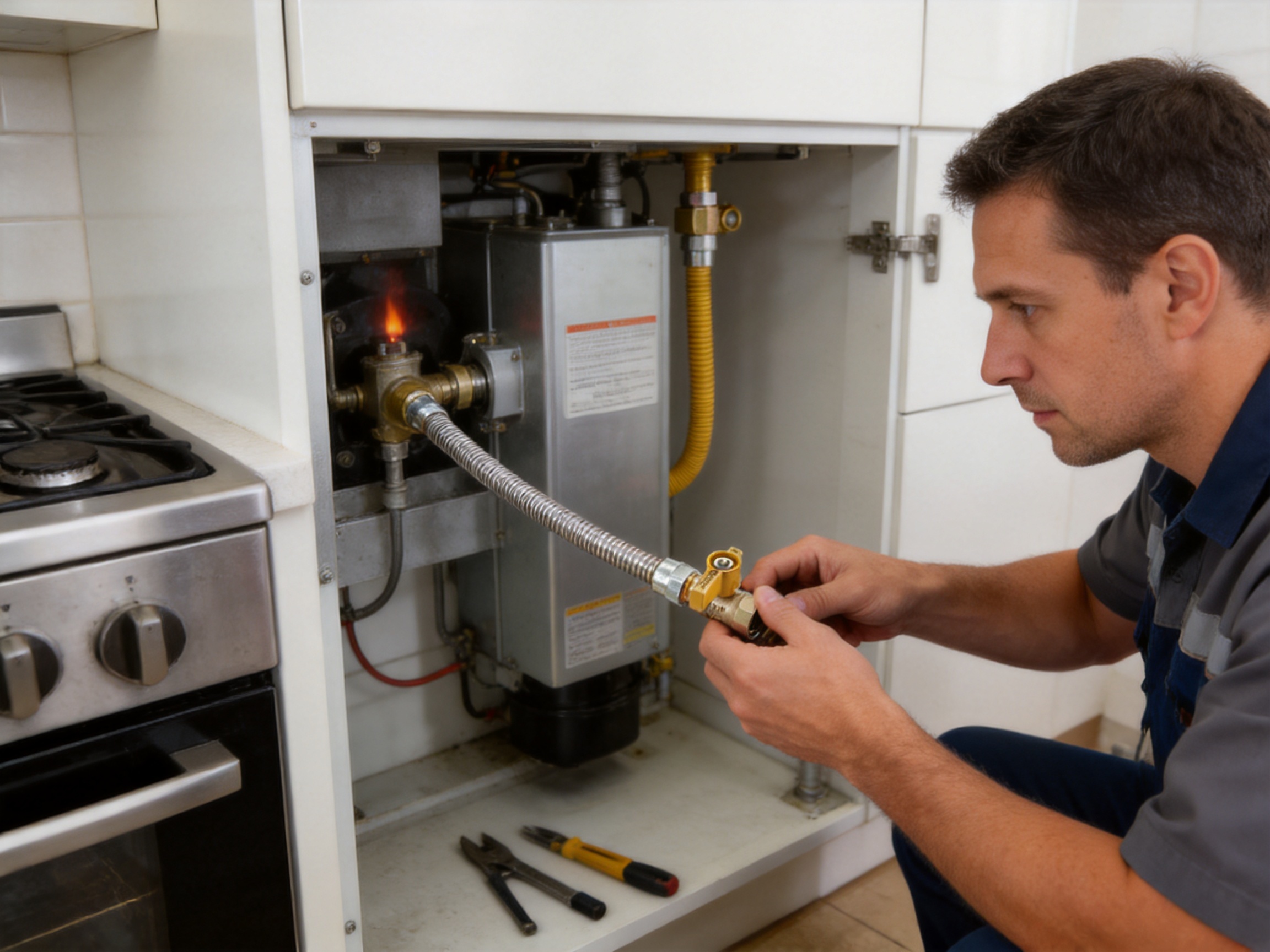
Correct installation is essential to connector performance. Before assembly, the installer should confirm the connector length, fitting type, thread specification, adapter arrangement, and appliance requirements. The connector and mating components should be inspected for dents, damaged threads, contamination, distorted flare surfaces, or other visible defects.
The connector should be routed with smooth bends and without twisting. Twisting can place torsional stress on the flare fittings and may reduce the connector’s ability to accommodate movement. The tube should not be used as a lever for aligning a mispositioned appliance. If the two ends do not naturally align, the system should be corrected through suitable pipework or fittings rather than forcing the connector into position.
The connector should not be stretched to reach a distant connection point. It should also not be installed with a tight coil or an abrupt bend near the fitting. Excessive deformation can concentrate stress in the corrugations and end areas. A suitable service loop may be allowed when required, but unnecessary slack should be avoided.
Flare surfaces should be clean and free of metal chips, dirt, oil, and sealing debris. The nut should start by hand to avoid cross-threading. Tightening should follow the relevant installation instructions and approved tools. Excessive torque can damage the flare or fitting, while insufficient torque may result in leakage. After installation, the system should be tested using an approved leak-detection method. Open flames must never be used to check for gas leakage.
Once installed, the connector should remain accessible for inspection where practical. It should be protected from sharp edges, abrasion, crushing, impact, direct flame, and excessive heat. It should not be painted, modified, welded, drilled, or repaired in the field. If damage or suspected leakage is found, the connector should be isolated and replaced according to the applicable safety procedure.
13. Selection Guidance for Buyers
Buyers should begin with the application rather than selecting only by price. The first questions should concern the gas type, operating pressure, temperature, installation location, required certification, appliance connection, and local regulatory requirements. Once these conditions are known, the correct product length and adapter combination can be selected.
Material verification is another important purchasing criterion. The product is specified as 304 stainless steel with a 0.2 millimeter wall thickness. Buyers should ensure that supplier documents, product labels, and purchase specifications identify the same material and configuration. For large orders, incoming material verification and sample inspection may be appropriate.
Fitting compatibility should be documented clearly. A purchase order should identify the flare nut specification and the adapter configuration, including whether the pipe-thread side is male or female and whether the nominal size is 3/8 inch or 1/2 inch. Ambiguous descriptions can lead to incorrect deliveries or installation delays.
Packaging and logistics also influence product value. Long connectors must be packaged in a way that protects the tube from crushing and prevents fitting damage. Automatic packaging capability can support consistent presentation and order handling. Distributors should discuss carton quantities, labeling, individual packaging, palletization, and traceability before placing volume orders.
Technical support is valuable when a product is supplied for multiple markets. The manufacturer should be able to provide specifications, product drawings where available, certification information, testing details, installation guidance, and responses to application questions. A supplier that supports the product after shipment can help reduce incorrect selection and improve customer satisfaction.
14. Why the Manufacturer Is a Strong Supply Partner
Haoyin (Ningbo) Bellows Technology Co., Ltd. combines product specialization, manufacturing equipment, quality management, and application experience. Its product portfolio includes gas connectors, plumbing pipes and water liners, metal hoses, and compensators. This broader product range indicates experience with flexible metallic connection systems across gas, water, heating, healthcare, building services, and industrial applications.
The company’s specialization in stainless steel bellows is especially relevant to the DN10 connector. Bellows and corrugated tubes require attention to thin-wall forming, fatigue behavior, weld integrity, and dimensional consistency. These technical requirements are closely related to the production of reliable flexible gas connectors.
The company’s facilities, research team, testing equipment, and automated production resources support both standard and customized supply. Customers may benefit from a manufacturer capable of discussing adapter changes, length requirements, appearance options, packaging needs, and application-specific development. This can be more efficient than working with a trading company that has limited control over the underlying production process.
Environmental and occupational management systems also contribute to supplier resilience. Organized production, controlled processes, worker safety, and environmental responsibility can reduce disruption and support stable long-term cooperation. For distributors and equipment manufacturers, supplier stability is an important part of total product value.
15. Maintenance and Service Life Considerations
A gas connector does not normally require complex maintenance, but it should be included in routine appliance and gas-system inspections. The inspection should look for corrosion, dents, kinks, abrasion, discoloration caused by overheating, damaged fittings, loose connections, and signs of movement or strain.
The inspection interval depends on the application and local requirements. Commercial kitchens, industrial equipment rooms, and high-use facilities may need more frequent checks than occasional residential applications. Any connector exposed to unusual heat, chemical cleaning agents, flooding, impact, or repeated appliance movement should be evaluated promptly.
Service life cannot be stated responsibly without knowing the operating environment, installation quality, gas conditions, pressure, temperature, movement cycles, and applicable standard. The 304 stainless steel material and controlled manufacturing process support durability, but they do not make the connector immune to misuse or environmental damage.
Replacement should be considered if the connector is visibly damaged, has been severely bent, shows leakage, has distorted flare surfaces, or has been subjected to a fire or major mechanical event. Reusing a connector after it has been removed may not be appropriate, particularly if the flare sealing surface has been marked or the tube has experienced repeated deformation.
16. Frequently Asked Questions
What is the main purpose of the DN10 stainless steel gas connector?
It provides a flexible metallic connection between a gas appliance or piece of equipment and a fixed gas supply line. Its purpose is to simplify routing, accommodate limited movement and alignment differences, and provide a durable gas pathway when correctly selected and installed.
What material is used for the connector tube?
The connector tube is made from 304 stainless steel. The stated wall thickness is 0.2 millimeters. This material provides corrosion resistance and a durable metallic structure for general residential, commercial, and selected industrial gas applications.
What flare nut specification does the product use?
The product uses a 5/8-18UNF flare nut. The mating connection must be compatible with this specification and with the correct flare geometry. Thread size alone should not be used to confirm compatibility.
Which adapter configurations are available?
The listed configurations include 3/8 inch outside diameter flare to 3/8 inch male pipe thread, 3/8 inch outside diameter flare to 3/8 inch female pipe thread, 3/8 inch outside diameter flare to 1/2 inch male pipe thread with a 3/8 inch female pipe thread option, and 3/8 inch outside diameter flare to 1/2 inch female pipe thread. The exact configuration should be confirmed before ordering.
What lengths can customers choose?
Available lengths are 12, 18, 24, 36, 48, 60, and 72 inches. The correct length should allow a smooth, unstressed route without excessive slack or sharp bending.
Is the connector suitable for residential kitchens?
It is designed for residential and commercial gas systems and may be suitable for kitchen appliances when the connector configuration, certification, pressure rating, temperature limits, and local installation requirements are satisfied. Installation should follow the appliance instructions and be completed by a qualified person where required.
Does the connector include an external protective cover?
The supplied specification lists the cover material as none. This means the product is described as a metal connector without an additional protective cover. It should therefore be routed carefully away from abrasion, sharp edges, direct flame, and excessive heat.
What does hard sealing mean in this product specification?
Hard sealing refers to a sealing arrangement based on the mating metallic surfaces of the flare connection. A clean, correctly aligned, undamaged flare interface is essential. The fitting should be tightened according to the applicable instructions, and the completed system should be checked for leakage using an approved method.
Can the connector be bent repeatedly?
The corrugated tube is flexible, but it should not be repeatedly bent, twisted, kinked, crushed, or forced beyond its intended routing limits. A smooth installation path is preferred. If the appliance is frequently moved, the complete installation should be evaluated for suitability and compliance.
What makes this product different from a low-cost generic connector?
The product provides defined material information, wall thickness, flare nut specification, adapter choices, length options, and a stated sealing form. It is manufactured by a company specializing in stainless steel bellows and flexible connections, with laser welding, CNC forming, eddy current inspection, performance testing, and automated packaging capabilities.
Does the company provide certified products?
The product category identifies the connector as having a CSA certificate designation, while the company information states that it has ISO9001, ISO14001, and ISO45001 management system certifications. Customers should request documentation for the exact product configuration and intended market before purchase.
What should be checked before ordering?
Buyers should verify gas type, operating conditions, required certification, connector length, flare specification, adapter gender, nominal thread size, material, color, nut material, packaging, and delivery requirements. Product documentation should be matched to the exact model being ordered.
How should a suspected damaged connector be handled?
The gas supply should be handled according to the applicable safety procedure, and the connector should not be repaired, welded, painted, or modified in the field. A qualified professional should inspect the system and replace the connector if damage or leakage is suspected.
17. Conclusion
The DN10 stainless steel gas connector is a practical solution for gas installations that require flexibility, corrosion resistance, connection versatility, and dependable metal sealing. Its 304 stainless steel construction and 0.2 millimeter wall thickness provide a carefully balanced foundation for a lightweight yet durable flexible tube. The 5/8-18UNF flare nut and selection of adapter configurations support different appliance and pipe interfaces, while the 12 to 72 inch length range helps installers select a suitable routing distance.
Its advantages over rigid pipe, ordinary uncoated steel, and poorly documented generic connectors arise from the combination of material quality, flexible corrugated construction, defined fittings, and manufacturing control. The product is not intended to eliminate the need for professional design or correct installation. Instead, it provides a reliable component that can make appropriate gas connection work more efficient and manageable.
The manufacturer strengthens the product offering through specialized stainless steel bellows expertise, standardized workshops, research and development resources, laser welding, CNC forming, COSMO equipment, eddy current flaw detection, performance testing, and automatic packaging. Its ISO9001, ISO14001, and ISO45001 management systems further support a structured approach to quality, environmental responsibility, and workplace safety.
For distributors, contractors, equipment manufacturers, and project purchasers, the product offers a useful combination of technical specification and supply flexibility. Correct selection remains essential. When the connector is matched to the gas system, installed without twisting or excessive bending, protected from heat and abrasion, and inspected according to applicable requirements, it can provide a safe and durable connection solution for residential, commercial, heating, and selected industrial applications.
References
1. Product specification provided for the DN10 stainless steel gas connector, including material, wall thickness, flare nut, adapters, lengths, colors, nut materials, and sealing form.
2. Manufacturer information for Haoyin (Ningbo) Bellows Technology Co., Ltd., including company capabilities, product categories, facility information, management system certifications, and manufacturing equipment.
3. General engineering principles for corrugated stainless steel flexible connectors, flare fittings, metallic sealing interfaces, and appliance connection design.
4. General quality management practices for metal tube forming, laser welding, dimensional inspection, nondestructive testing, performance verification, and automated packaging.
5. General installation and safety practices for flexible gas connectors, appliance connections, threaded adapters, leak testing, routing, inspection, and replacement.
6. Applicable local gas installation codes, appliance manufacturer instructions, certification requirements, and product standards for the destination market.