



 English
 Español
 русский



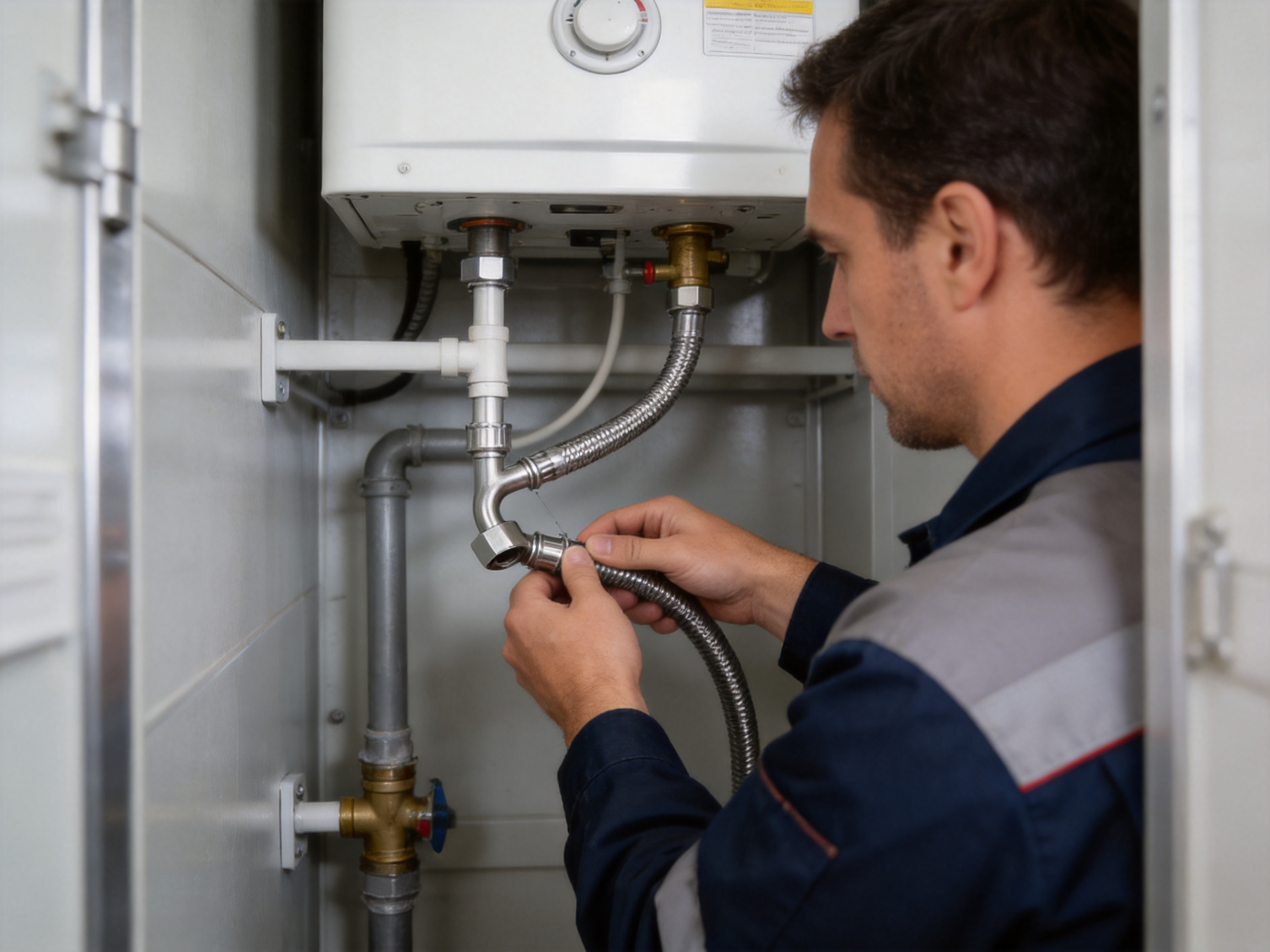
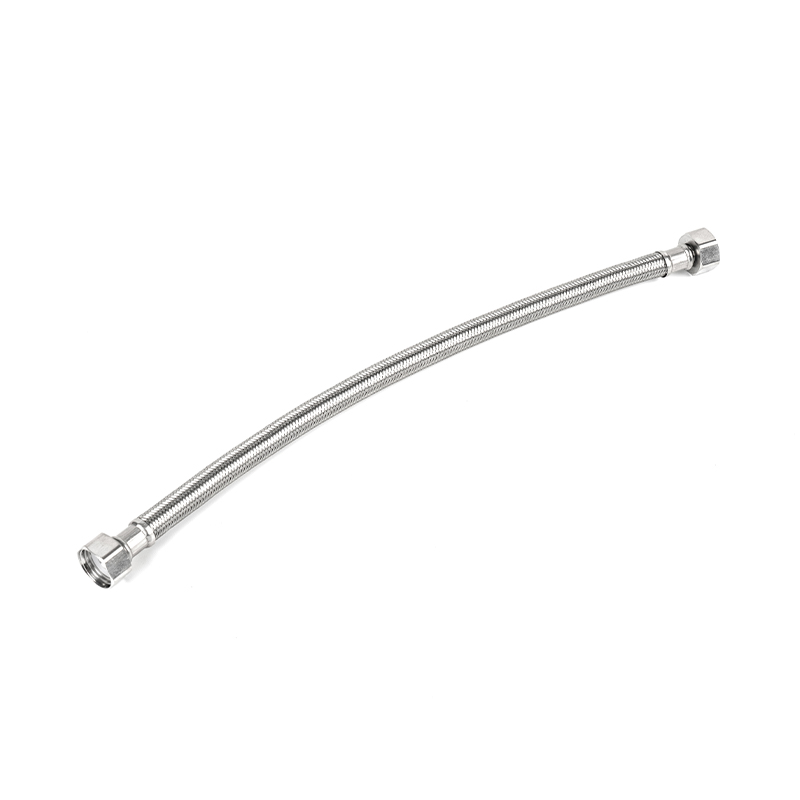
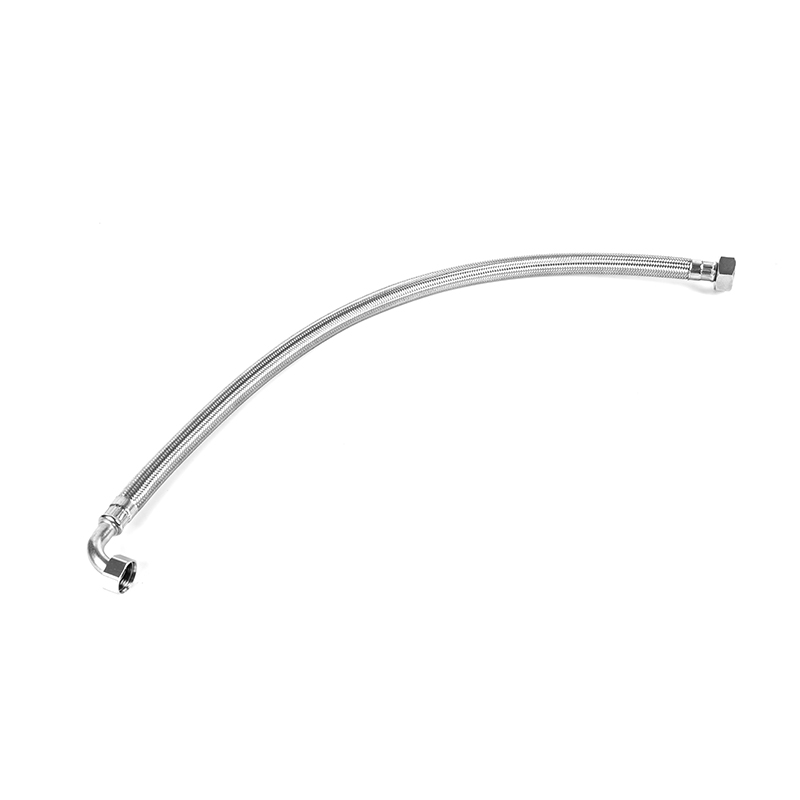
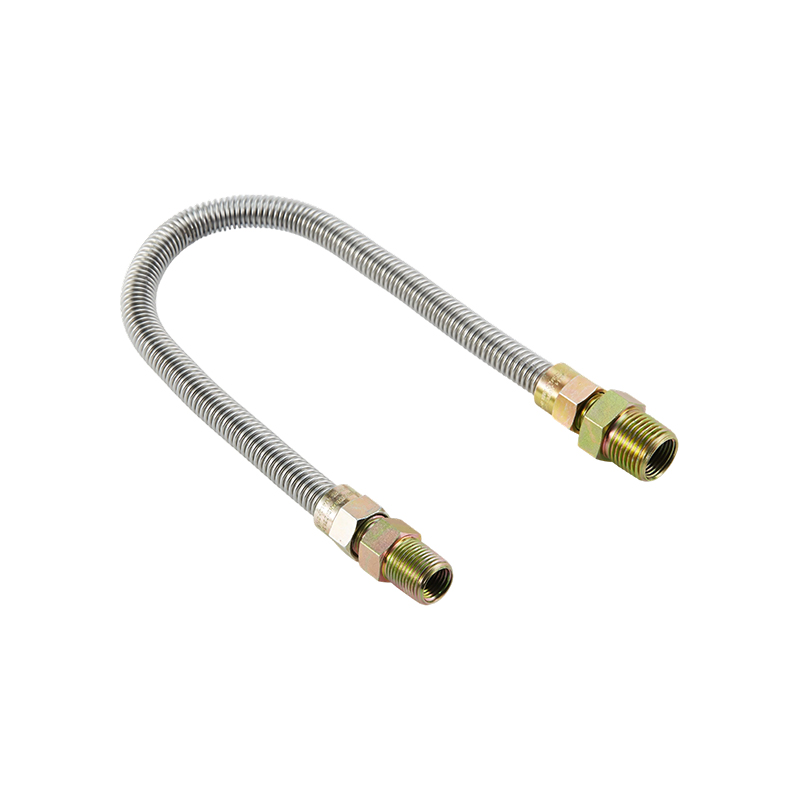
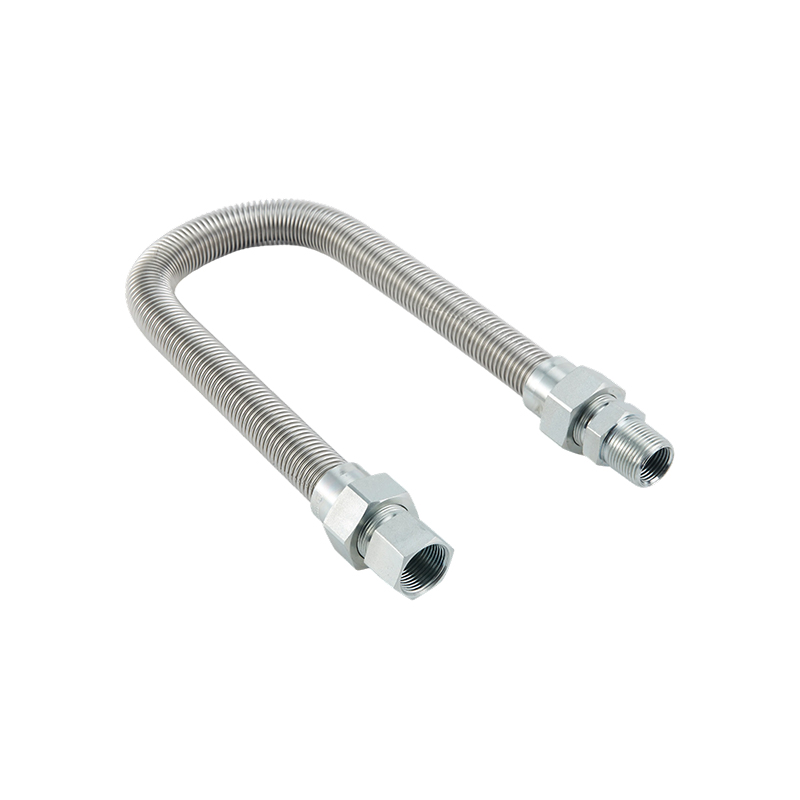
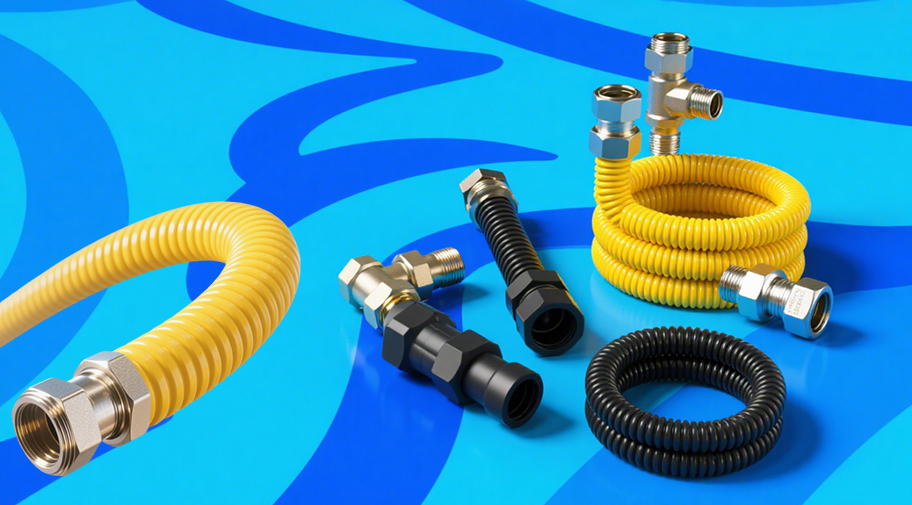
Flexible piping connections are essential wherever equipment must be connected safely, efficiently, and with enough movement to accommodate installation conditions. In residential buildings, commercial kitchens, heating systems, industrial facilities, and mechanical rooms, rigid pipes are not always practical. Limited space, equipment vibration, alignment differences, thermal expansion, and changing connection angles can make conventional piping difficult to install and maintain. A flexible stainless steel connector with elbow fittings provides a practical solution by combining the adaptability of corrugated tubing with the stability of reinforced end connections.
This type of connector is designed for applications involving gas, water, heating media, air, and other compatible fluids. Its stainless steel corrugated tube can bend around obstacles and fit into confined spaces, while its elbow fittings simplify connection to equipment positioned at different angles. The result is a compact and dependable connection assembly that can reduce installation difficulty, control mechanical stress, and support long-term piping performance.
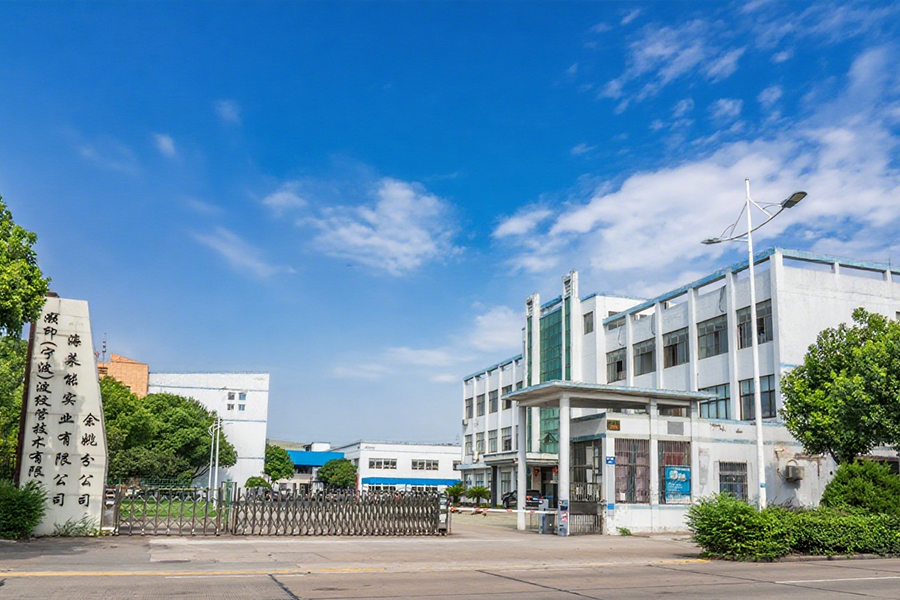
Manufactured by Haoyin (Ningbo) Bellows Technology Co., Ltd., this flexible stainless steel connector reflects the company’s experience in bellows, flexible piping, gas connectors, plumbing liners, metal hoses, and compensators. Through controlled material selection, precision forming, laser welding, inspection, and organized quality management, the product is developed to satisfy the demanding requirements of modern piping installations.
1. The Role of Flexible Connectors in Piping Systems
A connection pipe may appear to be a small component within a larger piping system, but its performance can influence the safety, service life, and maintainability of the entire installation. Equipment connections often experience movement that is not obvious during initial installation. Pumps create vibration, boilers generate heat, water heaters expand and contract during operation, and kitchen equipment may be moved or serviced repeatedly. Even when the movement is small, a rigid connection can transfer excessive force to threads, valves, appliance inlets, or fixed pipe supports.
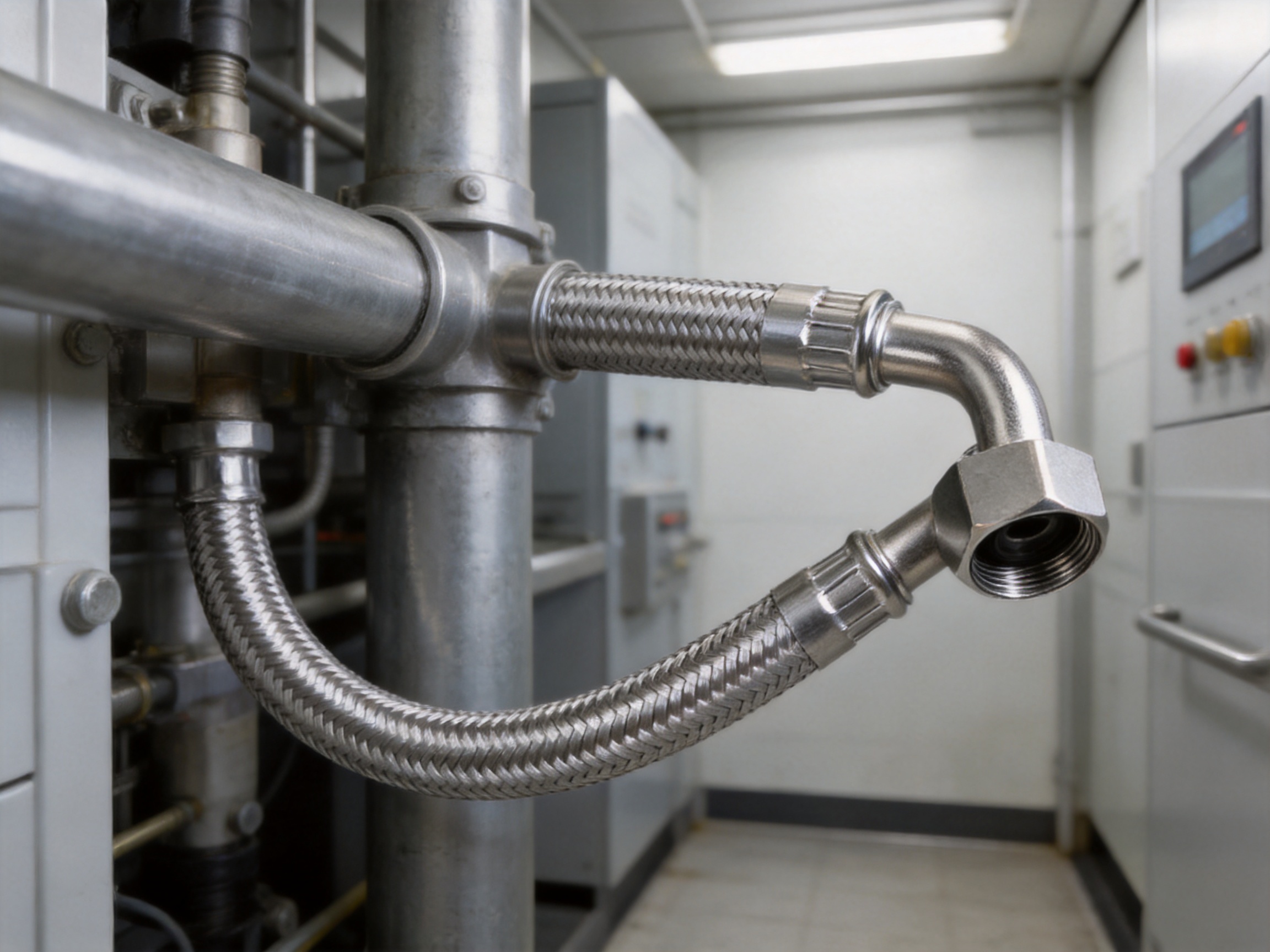
A flexible stainless steel connector is designed to absorb or accommodate limited movement while maintaining a secure flow path. The corrugated tube provides flexibility in multiple directions, allowing the installer to achieve the required routing without forcing the pipe into a sharp or unnatural position. This flexibility is particularly valuable when the available installation space is narrow or when the equipment outlet does not align perfectly with the building pipeline.
Elbow fittings add another important function. A conventional straight connector may require an additional elbow, adapter, or rigid pipe section to reach a side-facing or downward-facing equipment inlet. Each extra component introduces another joint, another potential leakage point, and another installation step. An integrated elbow fitting can simplify the assembly, reduce the number of connections, and create a more direct route between the supply line and the equipment.
The combination of a flexible corrugated body and reinforced elbow ends makes this connector suitable for many connection situations where a straight hose or rigid pipe would be inconvenient. It offers installation flexibility without sacrificing the stability required for safe service.
2. Product Construction and Functional Design
2.1 Corrugated Stainless Steel Tube
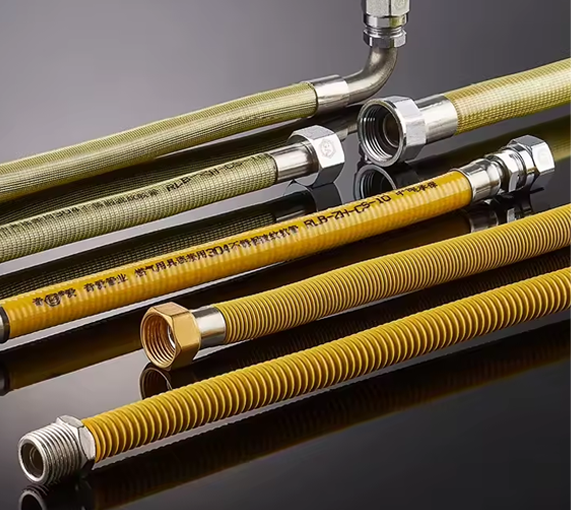
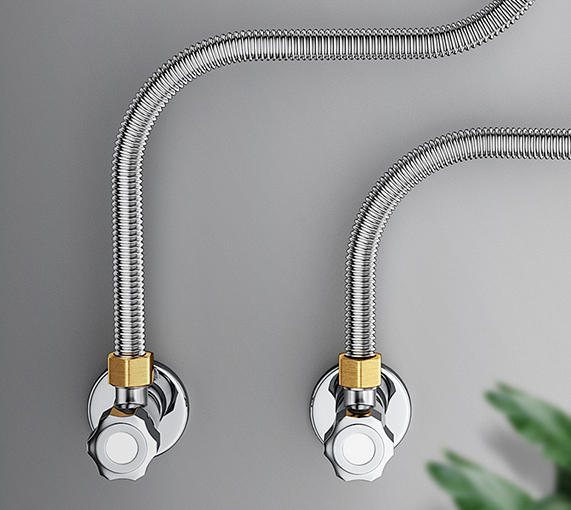
The central body of the connector is made from stainless steel corrugated tubing. Corrugation gives the tube a series of carefully formed waves that increase its ability to bend while maintaining a continuous internal passage. Compared with a plain rigid tube, the corrugated structure can accommodate routing changes and limited movement without requiring a large bending radius.
Stainless steel is selected because it offers a valuable combination of strength, corrosion resistance, temperature tolerance, and durability. In plumbing and heating environments, the tube may be exposed to moisture, condensation, cleaning chemicals, changing temperatures, or humid air. A suitable stainless steel construction can resist deterioration more effectively than many ordinary carbon steel alternatives.
The corrugated design also supports compact installation. Rather than requiring a long series of rigid elbows, the connector can be routed around nearby components, cabinets, brackets, and walls. This helps installers work more efficiently and can make the final assembly cleaner and easier to inspect.
2.2 Reinforced Elbow Fittings
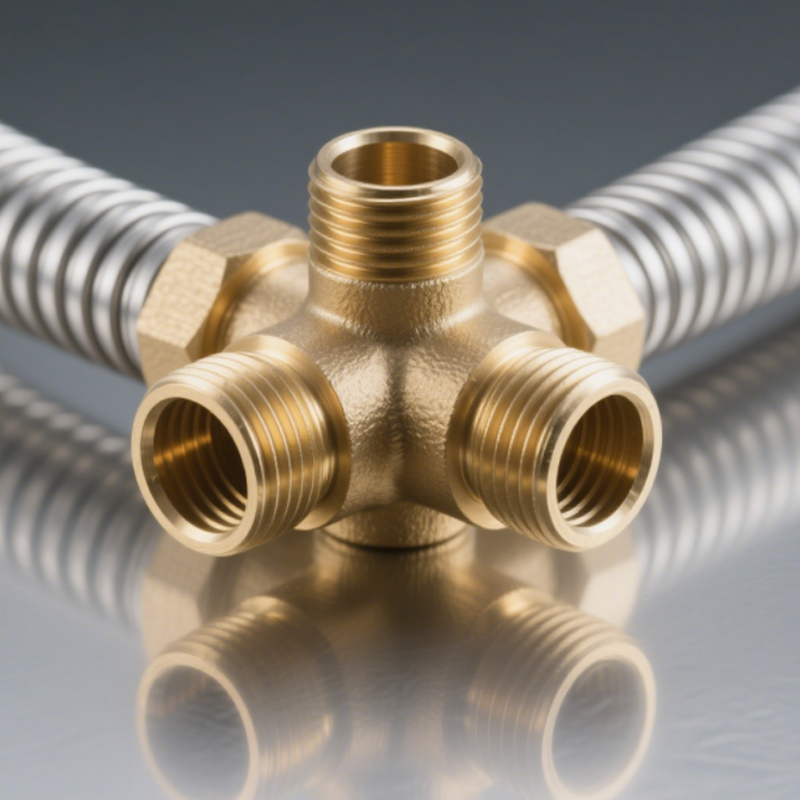
The elbow fittings at both ends are designed to improve connection stability and facilitate installation. Their angled configuration is useful when the connected interfaces face different directions. In a kitchen appliance, for example, the equipment inlet may be located close to a wall or beneath a worktop, while the supply line approaches from the side. An elbow-ended connector can reduce the need for forced bending at the fitting and create a more natural connection path.
Thickened elbow sections provide additional structural support near the connection areas. The ends of a flexible hose are often exposed to higher mechanical loads because they transfer forces between the flexible tube and the fixed equipment or pipeline. Reinforced fittings help manage these loads and can reduce stress concentration at the transition between the corrugated body and the connection end.
The elbow fittings can also contribute to easier alignment. During installation, the connector may be positioned so that the fittings face the required direction before final tightening. This can reduce twisting and help the installer create a more orderly layout. Correct orientation is especially important in restricted spaces where tools, access panels, and adjacent components may limit movement.
2.3 Integrated Connection Solution
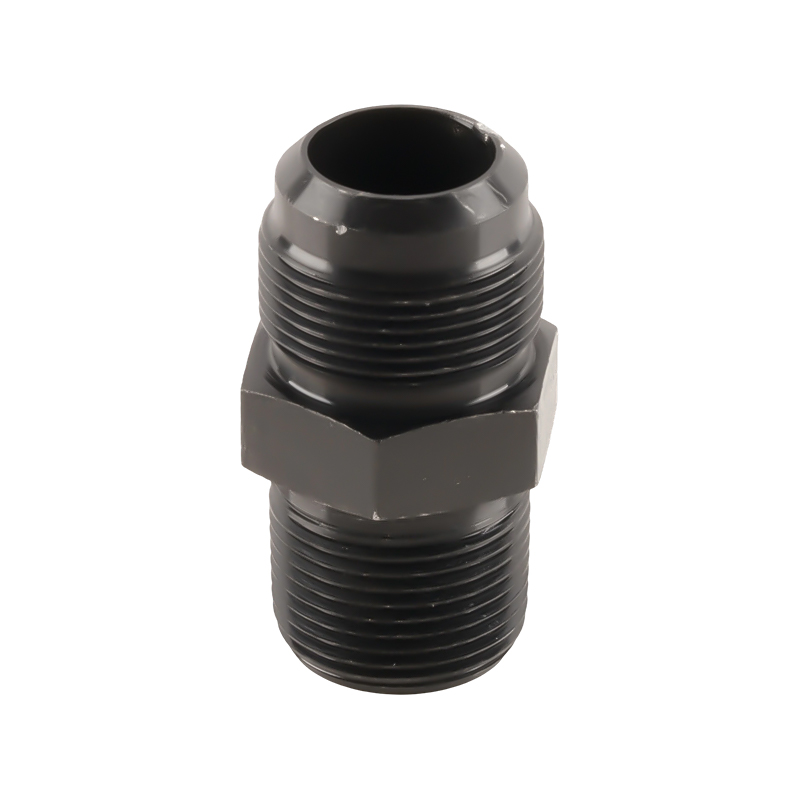
Instead of treating the tube, elbows, and adapters as separate pieces, this product provides an integrated connection assembly. Fewer separate components can mean fewer opportunities for incorrect selection, cross-threading, misalignment, or leakage. An integrated product can also simplify purchasing and inventory management for contractors, distributors, equipment manufacturers, and maintenance departments.
The exact end-thread configuration, nominal size, length, sealing method, and pressure rating should always be confirmed according to the application. Product selection must be based on the actual medium, operating temperature, working pressure, connection standard, installation environment, and applicable local codes. The flexible connector is a connection component, not a substitute for engineering review or proper installation practice.
| Design Feature | Practical Function | Installation Benefit |
|---|---|---|
| Stainless steel corrugated tube | Provides flexibility, corrosion resistance, and a durable flow path | Allows routing through confined or irregular spaces |
| Elbow fittings at both ends | Connect equipment interfaces positioned at different angles | Reduces the need for additional elbows and rigid adapters |
| Thickened end construction | Improves support at high-stress connection zones | Helps reduce local stress concentration during installation |
| Flexible integrated assembly | Accommodates limited movement and alignment variation | Supports faster and cleaner installation |
| Stainless steel material | Supports resistance to moisture, corrosion, heat, and aging | Helps extend service life in demanding environments |
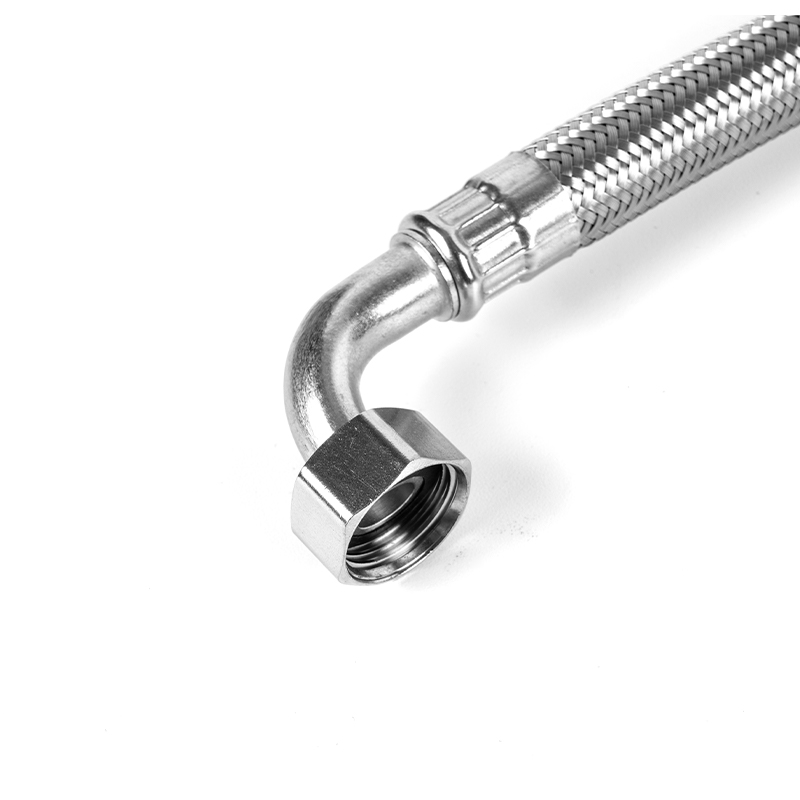
Flexible Stainless Steel Connector with Elbow Fitting
3. Main Advantages Compared with Conventional Alternatives
3.1 Easier Installation in Confined Spaces
One of the most important advantages of a flexible connector is its ability to work where rigid piping is difficult to install. Mechanical rooms, kitchen cabinets, boiler compartments, utility closets, and equipment enclosures often contain multiple pipes, valves, wires, insulation layers, and structural supports. There may be very little room to rotate a wrench or position a rigid pipe section.
The corrugated tube can be guided around obstacles and adjusted to the actual site conditions. This can reduce the amount of field cutting, threading, welding, or modification required. Installers can often complete the connection with fewer operations, which saves time and reduces the risk of installation errors.
Its flexibility should not be confused with unlimited bending capability. The tube must be routed according to the manufacturer’s bending guidance, and repeated sharp bending should be avoided. Nevertheless, within its intended operating range, the connector offers significantly more layout freedom than a straight rigid tube.
3.2 Better Alignment with Equipment Interfaces
Equipment connections are not always positioned exactly where a design drawing predicts. Manufacturing tolerances, building construction deviations, replacement equipment, and field modifications may create small differences in distance or orientation. A rigid pipe assembly may need to be remade when the actual interface does not align with the planned location.
The flexible connector can accommodate limited offset and angular variation. Its elbow fittings further improve alignment by allowing the connector to approach the equipment from a more suitable direction. This reduces the tendency of installers to force the connection into position, an action that can place unwanted loads on the fitting, equipment inlet, or pipe support.
3.3 Reduced Stress Concentration
Stress concentration occurs when a load is focused on a small area rather than distributed through a suitable structure. In piping systems, stress may be created by forced alignment, excessive tightening, vibration, thermal movement, or the weight of unsupported pipe. If these forces are transferred directly to a threaded connection or appliance inlet, premature damage may occur.
The flexible body helps absorb limited movement and alignment differences. The reinforced elbow ends provide a more stable transition between the tube and the connected components. Together, these features can reduce the mechanical burden on the equipment connection, provided that the connector is correctly supported and installed without twisting.
3.4 Corrosion Resistance and Long-Term Durability
Corrosion resistance is a major consideration in plumbing, gas, heating, and HVAC applications. Moisture, condensation, cleaning products, salts, and atmospheric contaminants can attack unsuitable materials. Stainless steel offers a durable solution for many ordinary service environments, helping preserve the tube surface and structural integrity over time.
The product is also designed to resist aging. Unlike some low-quality flexible materials that may become brittle, crack, soften, or lose their shape under heat and environmental exposure, a properly manufactured stainless steel connector maintains its metallic structure across a broad range of service conditions. Its actual performance depends on the selected grade, medium compatibility, temperature, pressure, and surrounding environment, but stainless steel is widely recognized as a reliable material for demanding connection work.
3.5 Resistance to Temperature and Pressure Changes
Boilers, water heaters, heating equipment, and HVAC systems commonly experience changes in temperature and pressure. During startup and shutdown, components expand and contract. During normal operation, fluid pressure may fluctuate as valves open, pumps start, or demand changes.
A flexible corrugated connector can accommodate certain movement caused by thermal expansion and equipment vibration. Its stainless steel body is also suitable for applications where higher temperature resistance is required than that provided by ordinary plastic or low-grade rubber hoses. The connector should still be selected according to its approved working limits. A flexible pipe should never be used beyond its specified pressure, temperature, or chemical compatibility range.
3.6 Cleaner System Layout
A practical connection is not only one that functions; it should also be easy to understand and inspect. An elbow-ended connector can create a more organized route from the supply line to the equipment. This can reduce unnecessary loops, unsupported sections, and crowded assemblies.
A cleaner layout can benefit future maintenance. Technicians are more likely to identify the connection, shutoff valve, and flow direction quickly when the piping is arranged logically. Reduced clutter also makes it easier to inspect for abrasion, corrosion, movement, or signs of leakage.
4. Applications Across Different Industries
4.1 Gas Appliances and Gas Equipment
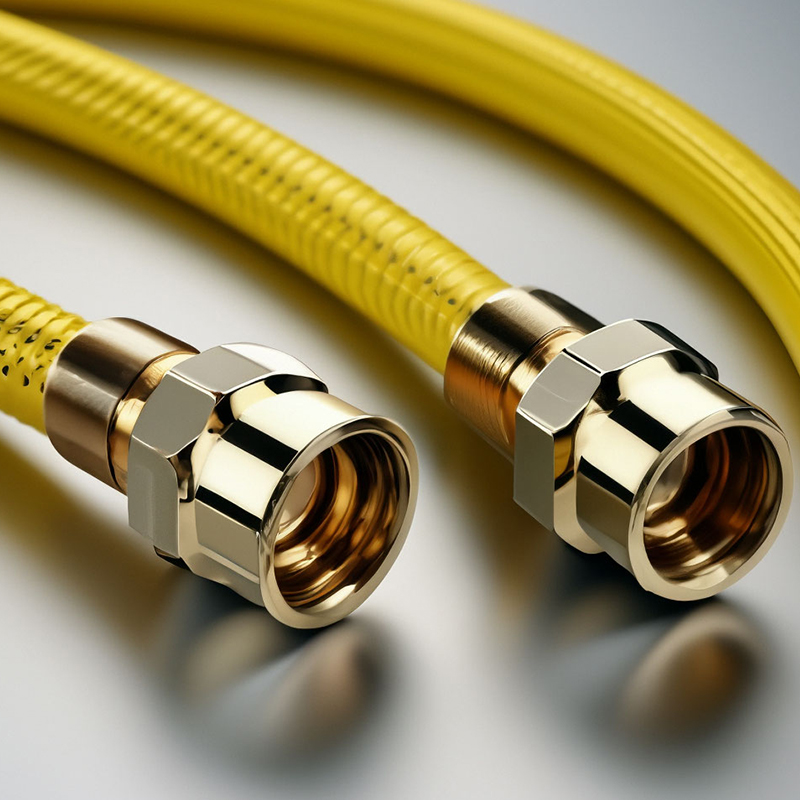
Flexible stainless steel connectors are frequently used to connect approved gas appliances and equipment to a fixed gas supply system. Typical applications may include domestic cooking appliances, commercial kitchen equipment, boilers, heating units, and other gas-fired devices. The connector’s flexibility helps accommodate equipment placement and service access, while the stainless steel construction provides a durable connection body.
Gas applications require particularly careful attention to standards, certification, sealing, installation orientation, leak testing, and local regulations. Only a connector approved for the specific gas service should be used. Installation should be performed by qualified personnel, and the connector should not be concealed, stretched, crushed, or exposed to conditions outside its design scope.
4.2 Water Heaters and Plumbing Equipment
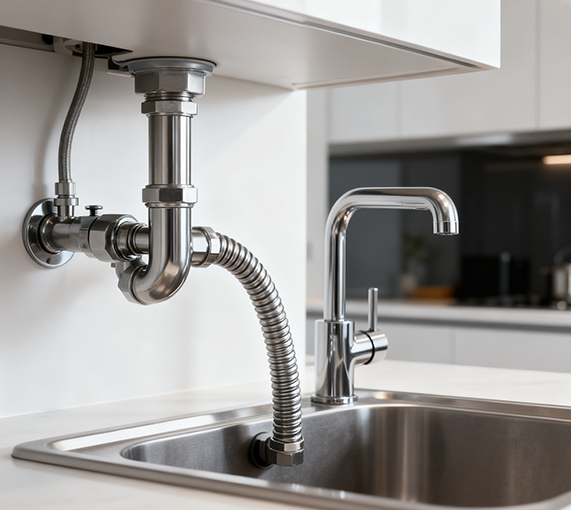
Water heaters often require connections that can tolerate temperature variation and minor equipment movement. A flexible stainless steel connector can simplify the connection between the heater and the building’s hot or cold water supply. Its flexibility is useful where the inlet and outlet do not align perfectly or where service access is limited.
For potable water systems, material compatibility and applicable hygiene requirements must be considered. The connector must be suitable for the water quality, temperature, pressure, and regulatory requirements of the installation. Proper flushing and cleanliness procedures should be followed where required.
4.3 HVAC and Heating Systems
Heating and HVAC equipment may generate vibration, thermal movement, and dimensional changes. Flexible connectors can help isolate or accommodate some of these effects between the equipment and the fixed piping. They may be used around boilers, heat exchangers, air-handling equipment, pumps, and related mechanical units, subject to engineering requirements.
In HVAC installations, the connector should be routed so that it does not carry the weight of adjacent pipework. Separate supports are normally needed for the fixed piping. The flexible section should be allowed to move within its intended range without rubbing against sharp edges, insulation supports, or nearby metal surfaces.
4.4 Commercial Kitchens
Commercial kitchens create demanding conditions for connection components. Equipment may be repositioned, floors and cabinets may be washed frequently, and the environment may contain heat, grease, humidity, and cleaning chemicals. A stainless steel flexible connector with elbow fittings can provide a durable and compact connection for compatible equipment.
The elbow configuration can be valuable below counters or behind appliances, where a straight connector may project too far or place stress on the equipment inlet. A well-planned flexible connection can also facilitate equipment servicing while helping maintain a neat kitchen layout.
4.5 Industrial and Utility Installations
Industrial equipment often requires flexible connections because of vibration, movement, thermal cycling, and complex routing. The product may be considered for compatible water, gas, heating, or utility services in factories, workshops, institutional buildings, and plant rooms.
Industrial use requires a more detailed assessment than ordinary residential use. Engineers should evaluate pressure surges, vibration frequency, chemical exposure, fatigue, support conditions, movement amplitude, and inspection requirements. Where the application involves severe cyclic movement or aggressive media, a specialized metal hose or compensator may be more suitable.
5. Manufacturing Process and Quality Control
5.1 Material Selection
Product reliability begins with the selection and control of raw materials. Stainless steel strip, tube material, fitting components, and sealing elements must be chosen according to the intended service. Material characteristics influence corrosion resistance, forming behavior, welding performance, pressure capability, and long-term durability.
A disciplined manufacturer maintains records for incoming materials and verifies that the materials correspond to the required specifications. Traceability supports more consistent production and helps identify the source of any deviation. Material handling and storage are also important because contamination, scratches, or incorrect mixing can affect finished product quality.
5.2 Precision Forming of the Corrugated Tube
The corrugated tube is formed through controlled mechanical processes that create a regular wave profile. The geometry of the corrugation influences flexibility, pressure performance, fatigue behavior, and flow characteristics. Excessive variation in wave height, pitch, wall thickness, or tube diameter can create inconsistent performance.
Haoyin uses CNC forming equipment and related manufacturing technologies to improve dimensional repeatability. Computer-controlled processes can maintain stable forming parameters across production batches and help reduce variation between individual connectors. Precision forming is especially important when the tube must be joined accurately to fittings at both ends.
5.3 Laser Welding and Joint Integrity
Welding is a critical operation in the manufacture of stainless steel flexible connectors. The weld must provide a continuous and reliable joint without excessive distortion, incomplete penetration, cracks, or contamination. Laser welding technology can offer concentrated energy input, accurate control, and a narrow heat-affected area when properly configured.
Controlled laser welding helps protect the geometry of thin stainless steel components and supports clean, repeatable joints. Welding parameters such as power, speed, focal position, shielding gas, and material fit-up must be managed carefully. Production personnel and process engineers must also monitor equipment condition and verify that the welding process remains stable.
After welding, appropriate inspection is necessary. Depending on the component and product specification, inspection may include visual examination, dimensional checks, leak testing, pressure testing, or non-destructive examination. A strong manufacturing system does not rely on welding skill alone; it combines controlled process parameters with objective verification.
5.4 Elbow Fitting Production
The elbow fittings require accurate geometry and adequate wall strength. Their angle, connection dimensions, end preparation, and surface condition all influence installation quality. If the elbow is not formed or machined accurately, it may create alignment problems or make sealing difficult.
Thickened elbow construction provides additional support in the connection zone. This design helps manage forces transferred between the flexible tube and the connected equipment. The fitting must still be protected from excessive torque during installation, since even a reinforced component can be damaged by improper tools or over-tightening.
5.5 Inspection and Testing
Quality control should cover the full production process rather than only the final appearance. Inspection may begin with raw materials and continue through forming, welding, fitting assembly, cleaning, packaging, and final release. Typical checks may include tube dimensions, corrugation consistency, fitting alignment, weld appearance, thread condition, surface cleanliness, and overall length.
Leak testing is particularly important for connectors used with gas or liquids. Pressure testing can help identify defects that are not visible during visual inspection. Eddy current flaw detection and other non-destructive inspection methods can support the identification of hidden discontinuities in suitable materials and geometries.
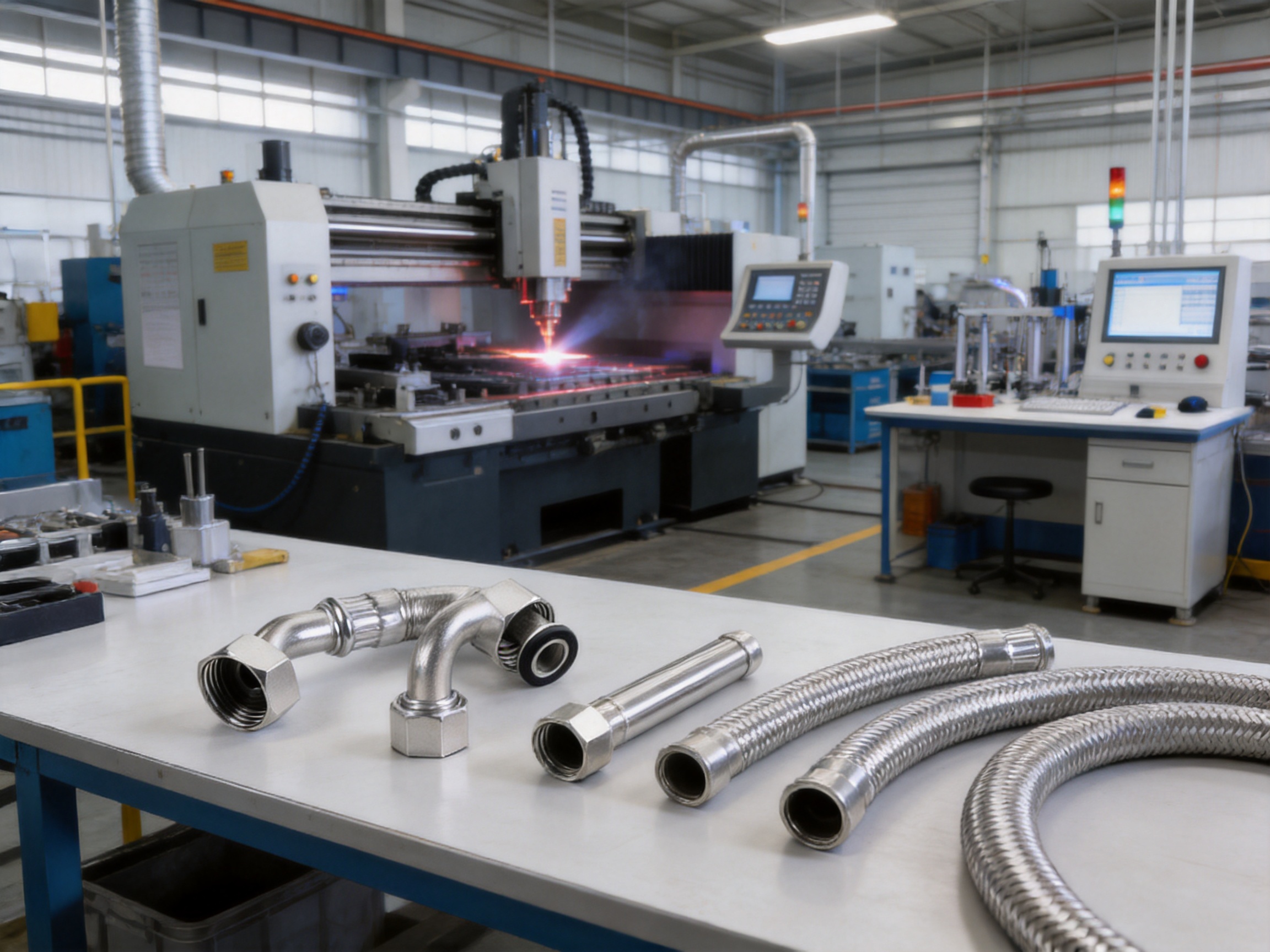
Haoyin’s manufacturing resources include COSMO equipment, eddy current flaw detectors, laser welding machines, CNC forming machines, and automatic packaging systems. This combination of equipment supports a structured production chain in which forming, joining, inspection, and packaging are coordinated rather than treated as isolated operations.
5.6 Automatic Packaging and Product Protection
Packaging is part of product quality because a correctly manufactured connector can still be damaged during handling or transportation. Threads, elbow surfaces, and stainless steel tubing should be protected from impact, contamination, and unnecessary deformation. Automatic packaging systems can improve consistency and help ensure that products are packed according to established procedures.
Clear labeling and organized packaging also support warehouse management and installation accuracy. Product identification should provide the information needed to distinguish sizes, lengths, connection types, and application categories. Correct packaging helps preserve the product condition until it reaches the installation site.
6. Manufacturing Strengths of the Supplier
Haoyin (Ningbo) Bellows Technology Co., Ltd. specializes in the research, development, design, manufacturing, and sales of stainless steel bellows and flexible connection products. Its product range includes gas connectors, plumbing pipes and water liners, metal hoses, and compensators. This specialization is relevant because flexible connectors require knowledge of forming, welding, movement, pressure, material behavior, and system integration.
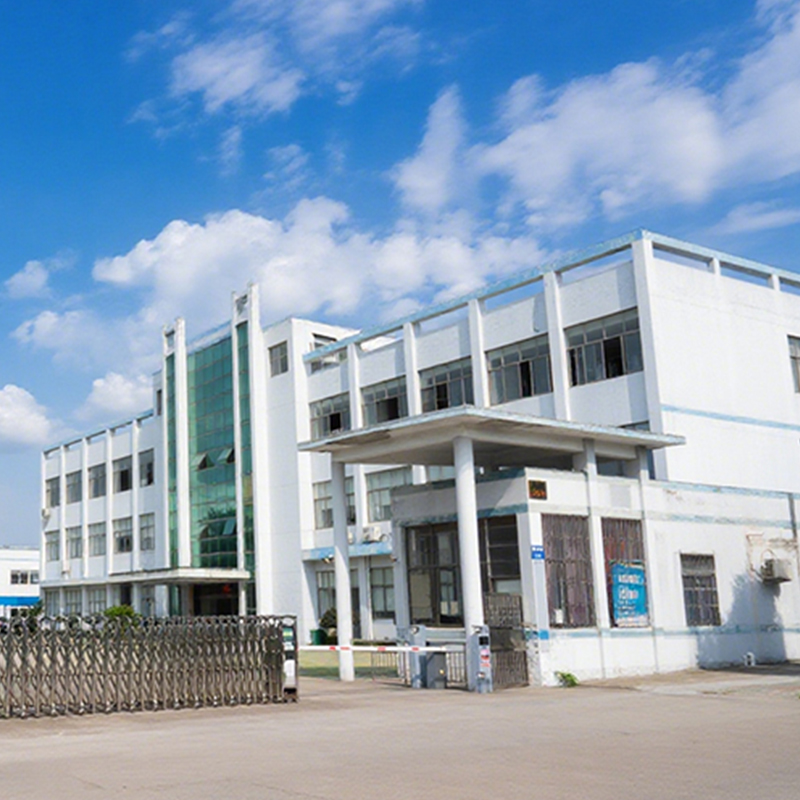
The company operates standardized workshops covering approximately 18,000 square meters across an area of about 35 mu. A dedicated manufacturing environment supports organized material flow, equipment placement, production management, and quality control. It also provides room for product development and the manufacture of different flexible piping categories.
The company has obtained ISO9001, ISO14001, ISO45001, and other management system certifications. These certifications indicate a structured approach to quality, environmental management, and occupational health and safety. Certification alone does not replace product-specific testing, but it demonstrates that the organization has established formal management processes for continuous control and improvement.
As a National High-tech Enterprise and Green Factory, Haoyin combines technical development with attention to environmental and operational responsibility. Its manufacturing philosophy emphasizes continuous improvement and quality-oriented production. The company’s stated approach, “Striving for Excellence, Forging Quality,” reflects the importance of consistent performance across design, manufacturing, testing, delivery, and after-sales support.
A professional research and development team supports product improvement and application adaptation. Flexible connectors may need to be optimized for different dimensions, connection standards, bending requirements, pressure classes, temperature conditions, and installation environments. R&D capability allows the manufacturer to study these requirements systematically rather than relying only on standardized products.
The company’s full-process quality management system covers raw material selection, structural design, manufacturing, performance testing, and after-sales support. This integrated approach is an advantage over suppliers that focus solely on low purchase price or basic assembly. For professional buyers, stable quality, technical communication, traceability, and service support can be just as important as the initial product cost.
7. Why Product Engineering Matters
A flexible connector should not be judged only by its appearance or ability to bend by hand. Product engineering determines how the tube behaves under pressure, how it responds to repeated movement, how the fittings transfer loads, and how the assembly performs after installation. A well-designed product balances flexibility with structural stability.
Too little flexibility makes installation difficult and increases alignment stress. Too much flexibility without sufficient support may allow unwanted movement, vibration, or fatigue. The corrugation profile, wall thickness, tube length, elbow geometry, weld design, and connection method must therefore work together.
Engineering also includes consideration of installation errors. A product that is easy to orient, inspect, and connect can help reduce field problems. Elbow fittings can make the intended routing more obvious, while reinforced ends can provide a more stable connection zone. However, the product must still be installed according to instructions, with adequate support and correct sealing methods.
For equipment manufacturers and system integrators, a reliable connector can simplify product design. It may reduce the need for custom rigid pipe assemblies and make equipment installation more adaptable to different building layouts. For contractors, it can shorten installation time and reduce the number of separate fittings required. For maintenance teams, it can make equipment replacement or disconnection more manageable.
8. Installation Guidance and Good Practice
8.1 Confirm Application Compatibility
Before installation, confirm that the connector is suitable for the intended medium. Gas, potable water, heating water, steam, refrigerant, compressed air, and chemical fluids have different requirements. The connector must also be compatible with the expected pressure, temperature, flow conditions, and environmental exposure.
For gas service, national and local regulations may specify approved connector types, maximum lengths, inspection requirements, and installation restrictions. A gas connector should be installed only by qualified personnel. For potable water, drinking-water approvals and hygiene requirements may apply.
8.2 Verify Size and Connection Type
Check the nominal diameter, end-thread standard, fitting orientation, overall length, and sealing arrangement before connecting the product. The connector should fit naturally between the two interfaces without being stretched or compressed. If an adapter is necessary, it should be selected to match the system standard and pressure requirements.
8.3 Avoid Twisting
Flexible corrugated tubing is designed to bend, not to function as a torsion spring. Twisting during installation can place stress on the corrugations, welds, and fittings. Installers should orient the elbow fittings first and then route the tube smoothly into position. Tools should be applied only to the designated fitting surfaces, not to the corrugated body.
8.4 Prevent Abrasion and Sharp Bends
The connector should not rub against sharp edges, unfinished brackets, moving parts, or abrasive surfaces. It should be routed with a suitable bending radius and without sharp kinks. Repeated movement should be assessed carefully, especially in locations exposed to vibration.
8.5 Support Adjacent Piping
A flexible connector should not be used to support the weight of a long pipe run or heavy valve assembly. Fixed piping should have its own supports, and equipment should be supported independently where necessary. Proper support reduces loads on the connector and helps maintain the intended movement pattern.
8.6 Inspect and Test Before Service
After installation, inspect the connector for visible damage, incorrect alignment, twisting, sharp bends, and contact with nearby surfaces. Perform the required pressure or leak test before placing the system into operation. Gas systems require appropriate leak detection procedures; open flames must never be used for leak testing.
9. Maintenance and Service Considerations
Stainless steel flexible connectors generally require limited maintenance when correctly selected and installed, but periodic inspection remains valuable. Maintenance personnel should check for corrosion, dents, abrasion, discoloration, leakage, fitting movement, and unexpected vibration. Any sign of damage should be evaluated before the system continues operating.
Connectors installed near heat sources should be inspected for evidence of overheating or exposure beyond the rated temperature. Connectors in commercial kitchens may require cleaning to remove grease and residues, but aggressive chemicals should be avoided unless material compatibility has been confirmed.
When equipment is moved for cleaning or repair, the connector should not be used as a handle or pulled beyond its natural position. If the equipment must be relocated, the supply should be isolated and the connector inspected after repositioning. A connector that has been kinked, crushed, or mechanically damaged should be replaced rather than returned to service without professional evaluation.
Replacement schedules depend on the application, local codes, operating conditions, and inspection results. Although stainless steel does not age in the same way as many polymeric materials, no connection component should be considered permanently maintenance-free. Correct inspection supports safe and reliable operation.
10. Sustainability and Lifecycle Value
The environmental value of a flexible connector should be considered across its entire lifecycle. A durable stainless steel product can reduce the frequency of replacement when compared with less suitable alternatives. Longer service life means less material consumption, fewer installation activities, and lower disposal volume over time.
Efficient installation may also reduce construction waste. A flexible connector can eliminate some cutting, threading, welding, and additional fitting operations. Fewer components can mean less packaging and fewer unused pieces left over after installation. These benefits depend on correct product selection and responsible installation practices.
Haoyin’s ISO14001 environmental management certification and Green Factory status indicate that environmental management is included in the company’s broader operational framework. Responsible manufacturing may involve energy management, waste control, process improvement, material utilization, and environmental compliance. Such systems are increasingly important for contractors and equipment manufacturers seeking reliable suppliers with documented management practices.
11. Selection Guide for Buyers and Engineers
Buyers should begin by identifying the service medium and the most demanding operating condition. The connector selected for cold water may not be appropriate for gas, hot water, steam, or a chemically aggressive fluid. The application should be clearly defined before requesting a quotation or approving a design.
Next, confirm the required dimensions and interfaces. Important details include nominal size, connection type, elbow direction, centerline dimensions, overall length, installation space, and required bending range. Drawings or photographs of the installation area can help the supplier recommend a suitable configuration.
Operating pressure and temperature must be considered together. Pressure capability can be affected by temperature, cyclic loading, and the condition of the connected system. Buyers should request the applicable technical data and ensure that the product’s working limits provide an appropriate safety margin.
Environmental conditions should also be reviewed. Outdoor installation, high humidity, salt exposure, chemical vapors, frequent washdown, vibration, and proximity to heat sources may affect material selection and service life. The stainless steel grade and surface condition should be selected accordingly.
Finally, buyers should evaluate supplier capability. A competitive supplier should be able to explain material selection, manufacturing processes, testing procedures, quality certifications, packaging, traceability, and technical support. A product with a low initial price may not provide the best value if it creates installation problems or premature replacement costs.
12. Frequently Asked Questions
Q1: What is a flexible stainless steel connector with elbow fittings?
It is a connection assembly consisting of a stainless steel corrugated flexible tube and elbow fittings at both ends. The flexible tube accommodates routing and limited movement, while the elbow fittings help connect equipment interfaces positioned at different angles.
Q2: Where can this connector be used?
It may be used for compatible gas, water, plumbing, heating, HVAC, kitchen equipment, boilers, water heaters, and industrial equipment applications. Suitability depends on the medium, pressure, temperature, connection standard, local regulations, and product certification.
Q3: What is the main advantage of the elbow fittings?
The elbow fittings can simplify alignment when the supply line and equipment inlet face different directions. They may reduce the need for separate elbows and help prevent forced bending near the connection points.
Q4: Is the connector suitable for gas?
A connector should be used for gas only when it is specifically approved and rated for the intended gas service. Gas installation must comply with applicable regulations and should be completed and tested by qualified professionals.
Q5: Can the connector replace all rigid piping?
No. The connector is intended for suitable equipment connection applications and limited movement accommodation. It should not be used as an unsupported replacement for long pipe runs, nor should it carry the weight of adjacent piping or heavy equipment.
Q6: Can the corrugated tube be twisted during installation?
No. The tube should be routed with smooth bends and protected from torsion, kinking, crushing, and excessive bending. The elbow fittings should be oriented correctly before final tightening.
Q7: How does stainless steel improve performance?
Stainless steel provides corrosion resistance, mechanical strength, temperature tolerance, and durability in many service environments. The actual performance depends on the selected material grade and compatibility with the application.
Q8: What quality controls are used during manufacturing?
Quality control may include raw material verification, precision forming, controlled laser welding, dimensional inspection, leak or pressure testing, non-destructive inspection, fitting checks, surface inspection, and protected packaging. The manufacturer uses CNC forming machines, laser welding equipment, eddy current flaw detectors, COSMO equipment, and automatic packaging systems.
Q9: How should the connector be maintained?
Inspect it periodically for leakage, corrosion, abrasion, dents, excessive movement, and fitting damage. Keep it free from sharp contact points and avoid moving connected equipment in a way that stresses the tube. Damaged connectors should be professionally assessed and replaced when necessary.
Q10: What information should be provided when requesting a quotation?
Provide the application medium, pressure, temperature, required length, nominal size, connection type, elbow orientation, installation environment, quantity, applicable standards, and any required certifications. Photos or drawings can help clarify the installation conditions.
13. Conclusion
The flexible stainless steel connector with elbow fittings is a practical solution for equipment connections that require flexibility, stability, corrosion resistance, and efficient installation. Its corrugated stainless steel body can adapt to confined spaces and limited alignment variation, while its reinforced elbow fittings help create a direct and reliable connection route. Compared with assemblies built from multiple rigid sections, it can reduce installation complexity, lower the number of separate joints, and minimize stress caused by forced alignment.
The product is suitable for a broad range of compatible applications, including gas equipment, water heaters, boilers, plumbing systems, HVAC units, commercial kitchens, and industrial equipment. Correct selection and installation remain essential. Pressure, temperature, medium compatibility, connection standards, support conditions, and local regulations must always be considered.
Its value is strengthened by the manufacturing capabilities behind it. Haoyin (Ningbo) Bellows Technology Co., Ltd. combines specialized bellows expertise, standardized workshops, professional R&D, precision CNC forming, laser welding, non-destructive inspection, performance testing, and automatic packaging. Its ISO9001, ISO14001, and ISO45001 management system certifications support a structured approach to quality, environmental responsibility, and occupational safety.
For contractors, equipment manufacturers, distributors, and engineering buyers, the connector offers more than simple flexibility. It represents an integrated connection solution supported by material knowledge, manufacturing discipline, and application-focused design. When selected according to service requirements and installed correctly, it can contribute to safer, cleaner, and more durable modern piping systems.
References
1. General principles of stainless steel material selection for plumbing, heating, gas, and HVAC connection components.
2. Industry practices for the design, forming, welding, inspection, and testing of corrugated metal hoses and flexible connectors.
3. Quality management principles based on ISO 9001 for manufacturing process control and continual improvement.
4. Environmental management principles based on ISO 14001 for responsible manufacturing operations.
5. Occupational health and safety management principles based on ISO 45001.
6. General installation practices for flexible gas connectors, water connections, heating equipment, and mechanical piping systems.
7. Manufacturer-provided product information concerning flexible stainless steel connectors, corrugated stainless steel tubing, elbow fittings, metal hoses, bellows, and compensators.
8. Manufacturer-provided information concerning CNC forming, laser welding, eddy current flaw detection, COSMO equipment, automatic packaging, and full-process quality management.